
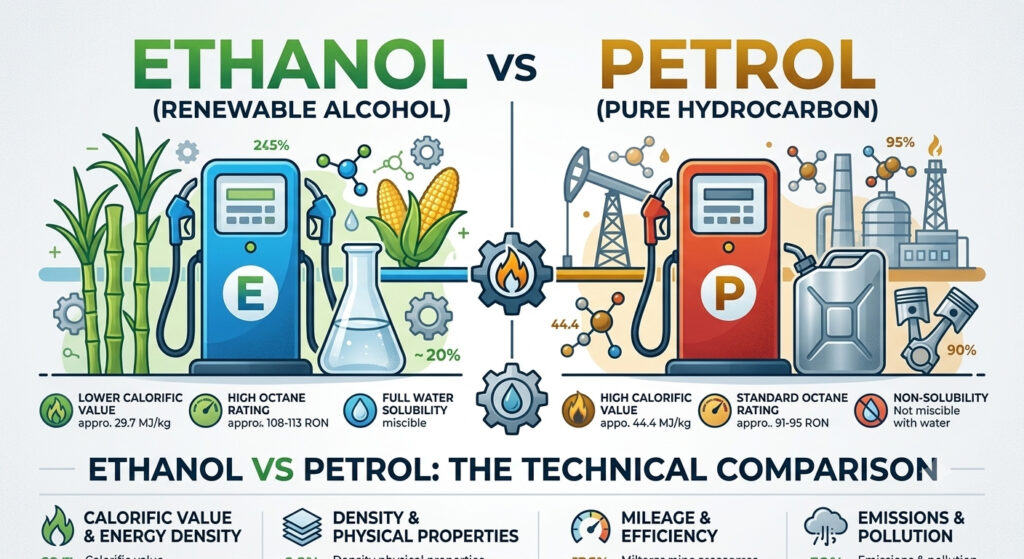
As fuel supply moves towards higher ethanol blends from E10, E20, E85, and E100, also. In such a situation, vehicle owners look for a data-backed answer to one question: how does ethanol actually compare to petrol as a fuel? In terms of combustion, mileage, cost, and vehicles’ engine compatibility. Therefore, this technical guide ensures to cover every piece of information for your vehicles, generators, and heavy machinery.
What is Ethanol, and why is it blended with petrol?
Ethanol is a renewable alcohol-based fuel, particularly developed by fermenting sugarcane, corn, or rice starch. Governments blend it into petrol, mostly visible in India’s ethanol blended petrol (EBP) programme, for three main reasons: 1. It is domestically generable to reduce crude oil import dependence. 2. It burns less emissions than pure petrol. 3. Ethanol’s higher octane rating is more effective for efficient combustion in modern engines.
Most countries are using E10 (10% ethanol) and E20 (20% ethanol), also in India, and this shift from petrol to ethanol raises questions about mileage and compatibility. And the guide below expresses this to anyone running petrol-powered engines. For a full breakdown of how E20 specifically affects heavy machinery, see our companion guide, Will E20 Petrol Damage Your Heavy Machinery?
Ethanol vs Petrol: Calorific Value Comparison
Calorific value (also called heating value) measures how much energy is produced when a fuel burns completely. Hence, this is one of the primary technical differences between the two fuels.
| Property | Ethanol | Petrol |
|---|---|---|
| Lower calorific value | ~29.7 MJ/kg | ~44.4 MJ/kg |
| Approximate difference | Ethanol carries roughly 33% less energy per kilogram than petrol | |
This gap exists because ethanol’s molecular structure already contains oxygen; it means it doesn’t release the same energy per unit mass during combustion as a pure hydrocarbon like petrol.
(Note: these are standard published physical-chemistry reference values for ethanol and gasoline. If your engineering team has measured values specific to your fuel supplier’s blend, use those for any load or performance calculations — treat the figures here as a general reference, not a substitute for supplier fuel specification sheets.)
Ethanol vs Petrol: Energy Density Comparison
Energy density is what is mentioned at the pump, and is what actually matters, while fuel is bought and stored by volume.
- Ethanol: approximately 24 MJ/litre
- Petrol: approximately 33–34 MJ/litre
Moreover, ethanol is denser than petrol; its energy-density gap per litre is smaller than the gap per kilogram. Yet it is still substantial at roughly 25–30% less energy per litre than pure petrol.
Ethanol vs Petrol: Density and Physical Properties
Ethanol’s higher octane rating is genuinely useful. It resists engine knock better than petrol, which is why high-performance and flex-fuel engines are ready to take advantage of ethanol blends. The main point is that ethanol’s full water miscibility is also why ethanol-blended fuel is more prone to phase separation and moisture absorption in long-term storage. A well-known concern for machines or equipment that sit idle for extended periods, like generators, backup pumps, and seasonal machinery.
| Property | Ethanol | Petrol |
|---|---|---|
| Density | ~0.789 g/mL | ~0.72–0.78 g/mL (varies by grade) |
| Octane rating (RON) | ~108–113 | ~91–95 (regular/premium) |
| Boiling point | 78.4°C | 25–225°C (range, multi-component fuel) |
| Water solubility | Fully miscible | Not miscible |
Ethanol vs Petrol: Mileage and Fuel Efficiency
This is the real question everyone cares about, and it follows the calorific value gap above. Ethanol carries less energy per litre than petrol, while vehicles and machinery running on higher ethanol blends generally figure a measurable drop in fuel efficiency (km/litre or hours of runtime per tank) compared to pure petrol.
Why E20 Reduces Mileage
There is no real figure for drops in mileage, but users say roughly a 6–8% drop in mileage compared to pure petrol. It depends upon the engine tuning, load, driving conditions, and whether engines are specifically tuned for higher ethanol content to improve combustion efficiency. If you are trying to find out the actual impact on mileage and fuel prices, check our Fuel Consumption & Cost Calculator, which lets you plug in your own numbers rather than rely on general averages.
Ethanol vs Petrol: Emissions and Pollution
Ethanol combustion produces lower carbon monoxide and particulate matter emissions than pure gas. It is because of the oxygen already present in the ethanol’s molecular structure. However, it is not a one-sided win; ethanol combustion can increase certain aldehyde emissions, andthe net well-to-wheel emissions benefit on how ethanol itself was produced. It reduces local air pollution, but the “zero pollution” framing is more complex.
Ethanol vs Diesel: Key Differences
Ethanol and diesel are both fundamentally different fuels and are not directly interchangeable in most engines without modification.
Combustion Type: Petrol/Ethanol engines depend on spark ignition, while diesel engines rely on compression ignition. Ethanol’s lower cetane number makes it poorly suited to standard diesel engines without significant modification.
Energy Density:Diesel has a higher energy density than petrol and ethanol (~35–36 MJ/litre), which is part of why diesel remains dominant for heavy-duty, high-torque applications like drilling, foundation, and construction equipment.
Blending: Ethanol and diesel blends, known as diesohol, also exist in research and pilot programmes; they require fuel additives to prevent phase separation.
Ethanol vs Biodiesel: Key Differences
Both are different chemically and functionally, and both are renewable fuels:
Ethanol: It is an alcohol, produced by fermentation, and blended with petrol for spark-ignition engines.
Biodiesel: It is a type of fatty-acid methyl ester, generated from vegetable oils or animal fats via transesterification, and is blended with diesel for compression ignition engines. For stabilize the conditions of your machine, check our diesel fuel additives list if it suits you.
Frequently Asked Questions