
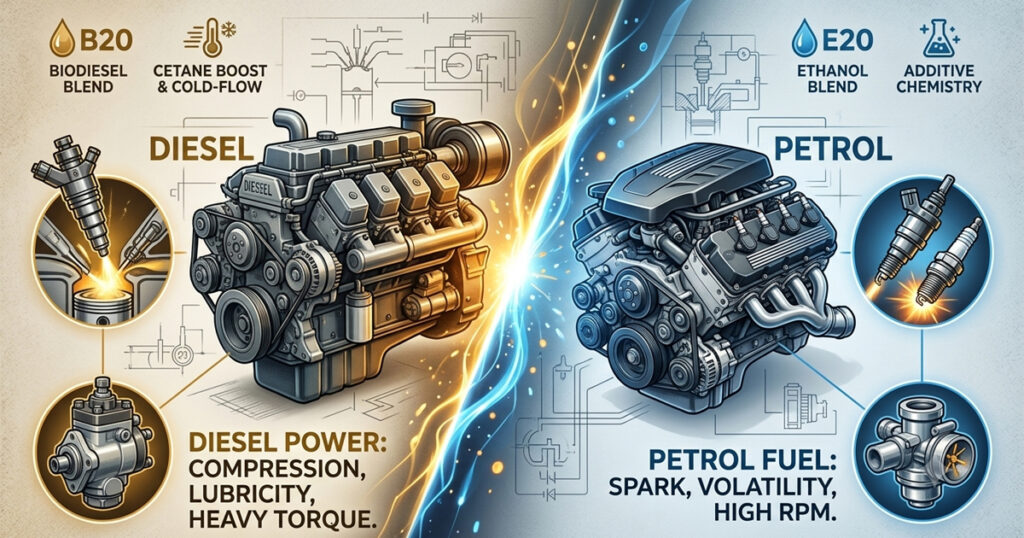
Diesel is not going away, but it is not standing still either. Nowadays, biodiesel blend mandates are rising alongside the ethanol crossover on the petrol side. Additionally, a new generation of petrol and diesel fuels is powering the world’s heaviest machinery. Hence, this technical and detailed guide compares diesel and petrol at a technical level, then walks through where diesel actually comes out ahead. Furthermore, B20 blending, additive chemistry, and fuel system components like filters, injectors, and pumps keep it running.
What is Diesel Fuel, and How is it Different from Petrol?
Diesel and petrol are both refined from crude oil, but they are developed as fundamentally different fuels for different combustion and ignition processes. Petrol is a lighter, more volatile fraction created to be ignited by a spark, while diesel is a heavier, less volatile fraction created to ignite under compression alone. Moreover, this ignition method defines the root of every distinction between diesel and petrol engines.
Diesel vs Petrol: Technical Comparison
Calorific Value and Energy Density
| Property | Diesel | Petrol |
|---|---|---|
| Lower calorific value | ~45.5 MJ/kg | ~44.4 MJ/kg |
| Energy density | ~35-36 MJ/litre | ~33-34 MJ/litre |
Diesel carries more energy per litre than petrol because of its higher density. Consequently, a greater mass of fuel fits into the same volume. This is the core technical reason why diesel engines are the default choice for heavy-duty, high-torque applications like construction and drilling equipment.
Density and Boiling Point
| Property | Diesel | Petrol |
|---|---|---|
| Density | ~0.83-0.85 g/mL | ~0.72-0.78 g/mL |
| Boiling point range | ~180-360°C | ~25-225°C |
Diesel’s higher boiling range reflects its heavier hydrocarbon composition. Because of this, diesel evaporates far more slowly than petrol at ambient temperatures.
Engine Type — Compression Ignition vs. Spark Ignition
Petrol engines use spark plugs to ignite an air-fuel mixture at a controlled moment. Diesel engines do not require a spark; instead, they compress air alone to a point where it becomes hot enough to ignite the injected fuel automatically. This is why diesel engines generally run at a higher compression ratio and generate more torque at lower RPMs. It is this characteristic that makes them dominant in excavators, cranes, and drilling rigs, where a sustained pulling and digging force is required rather than high-RPM power delivery.
Diesel vs Petrol: Mileage, Cost, and What Actually Sets Diesel Prices
Diesel engines typically offer better fuel economy than equivalent petrol engines. This is largely due to diesel’s higher energy density and the superior thermal efficiency of compression-ignition combustion. On pricing particularly, the price of diesel—like the price of petrol—moves according to crude oil costs, refining margins, taxation, and the logistical costs of timely delivery. Because fuel prices fluctuate on a daily basis and vary by region, you can check our fuel consumption & cost calculator to work out your own fuel costs and get estimates tailored to your machine.
The Future of Diesel: B20 and Biodiesel Blending
What is B20?
B20 is a blend of 20% biodiesel (typically created from vegetable oils, animal fats, or recycled oil via transesterification) and 80% conventional petroleum diesel. It is the diesel equivalent to E20 on the petrol side. Both blended fuels represent a push toward partial renewable energy within the existing fuel infrastructure.
How B20 Compares with Pure Diesel
B20 burns with lower sulfur emissions and fewer particulates than pure diesel, and it can be used in modern diesel engines without modification. However, older engines and certain seals or gaskets not rated for biodiesel exposure must be checked against manufacturer guidance first. Moreover, the energy content in B20 diesel is slightly less than that of pure diesel, meaning a small mileage trade-off is typical. This gap is generally smaller than the mileage impact of E20 on the petrol side, as both the blend ratio and the energy gap are smaller.
Where Ethanol Fits In: E20, Diesel, and Cross-Blending
Ethanol and diesel do not mix as directly as ethanol and petrol do. While diesel engines rely on compression-ignition, ethanol’s low cetane number makes it poorly suited to standard diesel combustion without significant additive support. This process of blending ethanol and diesel is also known as “diesohol.” It requires fuel additives to prevent phase separation and remains far less commercially developed than either E20 petrol blending or B20 biodiesel blending.
For an entire technical breakdown of how ethanol reacts in petrol engines, check our ethanol vs. petrol complete technical comparison. In practice, the two blending programmes—E20 on petrol and B20 on diesel—run parallel in their respective engine types.
Diesel Fuel Additives: Cetane Boosters, Lubricity, and Cold-Flow
Diesel fuel additives resolve specific chemical problems, much like the petrol-side additives covered in our top 5 fuel additives Top 5 Fuel Additives for 2026: Enhancing Engine Longevity and Efficiency guide. Cetane improvers: These shorten ignition delay, improving cold-start performance and reducing engine knock. This is especially valuable as biodiesel usage increases, since cetane numbers can vary between blend batches.
Lubricity additives: These replace the natural lubrication stripped out during the refining of ultra-low sulfur diesel, protecting the fuel pumps and injectors that depend upon the fuel itself for lubrication.
Cold-flow improvers: These prevent wax crystals from forming in diesel fuel at low temperatures, which is what causes fuel gelling and filter clogging in cold climates.
Demulsifiers/water separators: These address water contamination, which is a bigger concern in biodiesel blends because biodiesel is more hygroscopic than pure petroleum diesel.
Diesel Fuel System Components: Filters, Injectors, and Pumps
Diesel fuel filter: This removes particulate contamination and water from the fuel before it reaches the injection system. It is critical because modern high-pressure common-rail injectors work to exceptionally tight tolerances, meaning even small contaminants can cause disproportionate wear.
Diesel fuel injector: This forces fuel directly into the combustion chamber at very high pressure, precisely timed with the compression cycle. Because there is no spark plug to compensate for poor atomisation, the condition of the injectors has an outsized effect on diesel combustion efficiency compared to petrol engines.
Diesel fuel pump: This is responsible for building the injection pressure that makes precise, high-force fuel delivery possible. These pumps rely entirely on the fuel itself for lubrication.
Is Diesel’s Future Secure? Outlook for Heavy Machinery
For heavy machinery specifically—such as cranes, excavators, drilling rigs, piling rigs, and other diesel-operated equipment—the future looks durable even as blending mandates rise. The torque and energy-density advantages of compression-ignition remain hard to replace for sustained, heavy-duty work. Furthermore, B20-style biodiesel blending represents a gradual evolution of the existing diesel infrastructure rather than a total replacement for it. The key updates to watch moving forward will be how biodiesel energy requirements rise and how tightly emissions standards push the development of diesel fuel additives.
Frequently Asked Questions (FAQs)
Q: What is the main difference between diesel and petrol?
Ans: Diesel engines ignite fuel by compression alone, whereas petrol engines require a spark. This difference drives most other distinctions, including diesel’s higher torque output and its ability to produce more energy per litre than petrol.
Q: What determines diesel prices?
Ans: Diesel prices rely fundamentally on the cost of crude oil, alongside refining margins, regional taxation, and increasingly, the blending mandates for biodiesel—all of which affect the final pump price.
Q: How often should a diesel fuel filter be changed?
Ans: This depends on the manufacturer’s recommendations, fuel quality, operating habits, road conditions, traffic, and region. However, intervals should generally be shortened after switching to a higher biodiesel blend, as biodiesel can dislodge legacy tank deposits during the transition period.