
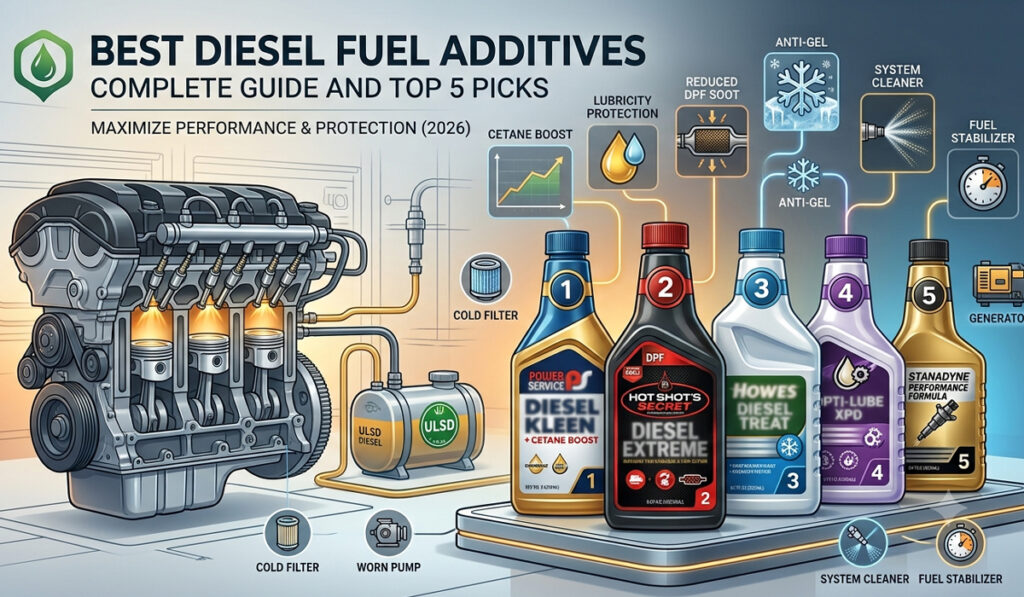
Diesel fuel additives are among the most searched—and misunderstood—topics in engine maintenance. While many products genuinely solve real chemical challenges in modern diesel fuel, others are heavily marketed with claims that far exceed what the chemistry can actually deliver. This guide breaks down what fuel additives really do, compares the five most reputable options on the market, and provides straight answers to help you choose the right one.
What Are Diesel Fuel Additives, and Do You Actually Need One?
A diesel fuel additive is a concentrated chemical treatment added directly to the fuel tank to address a specific deficiency in the base fuel. Common issues include insufficient lubrication, poor cold-weather flow, slow ignition, or fuel system deposits.
Whether you need an additive depends on your vehicle’s engine, local fuel quality, weather conditions, engine age, and how the vehicle is driven.
Why Modern Diesel (ULSD) Needs Additives More Than Older Diesel Did
This is the single most important context missing from most buying guides. Ultra-Low Sulfur Diesel (ULSD)—mandated across global markets to cut sulfur emissions—loses much of diesel’s natural lubricating properties during the refining process.
Fuel pumps and injectors designed around baseline fuel lubricity are now exposed to greater wear than they were on older, higher-sulfur diesel. Consequently, lubricity additives have shifted from an optional performance luxury to essential protection for most ULSD-powered engines.
Types of Diesel Fuel Additives
Cetane Boosters
Cetane measures how quickly diesel fuel ignites under compression—acting as the diesel equivalent of a gasoline octane rating, but in reverse. A higher cetane number means faster, more refined ignition. Cetane boosters shorten ignition delay, leading to smoother idling, reduced engine knock, and easier starts. Depending on the base fuel quality and product concentration, a booster can raise the cetane rating by several points.
Lubricity Additives
Designed to address the ULSD lubrication gap, these fatty-acid-based additives form a protective boundary film on high-pressure fuel pumps and injector surfaces, restoring the lubricity lost during sulfur removal.
Anti-Gel / Cold-Flow Additives
Diesel contains paraffin wax particles that crystallize in freezing temperatures, causing the fuel to cloud and eventually gel—clogging fuel filters. Anti-gel additives lower the fuel’s Cold Filter Plugging Point (CFPP) by disrupting crystal formation, keeping fuel flowing smoothly in winter conditions.
Injector and Fuel System Cleaners
These formulas target carbon and varnish deposits that accumulate on fuel injectors over time, restoring the correct spray pattern and fuel atomization. They are particularly critical for diesel engines because improper atomization severely degrades efficiency without a spark plug to compensate.
Fuel Stabilizers
Formulated for diesel that sits unused for extended periods—such as in backup generators, seasonal equipment, or heavy machinery—stabilizers slow down fuel oxidation and often include moisture-dispersing agents to combat water accumulation during long-term storage.
Top 5 Diesel Fuel Additives (2026 Picks)
1. Power Service Diesel Kleen + Cetane Boost
Best For: All-around maintenance and year-round use
Category: Cetane booster + injector cleaner
One of the most established additives on the market, this formula combines a high-potency cetane boost with detergent-based injector cleaners. It is an ideal default choice for regular preventive maintenance across all types of diesel engines.
2. Hot Shot’s Secret Diesel Extreme
Best For: Deep cleaning and DPF-equipped engines
Category: Injector/DPF cleaner + cetane booster
Specifically engineered for modern engines equipped with Diesel Particulate Filters (DPF), this concentrated treatment provides a deep system clean that optimizes combustion and helps reduce DPF regeneration cycles.
3. Howes Diesel Treat
Best For: Cold climates and severe winter operation
Category: Anti-gel / cold-flow additive
A top choice for sub-zero conditions, Howes Diesel Treat prevents fuel gelling and filter icing without using alcohol, making it a reliable insurance policy for winter driving.
4. Opti-Lube XPD
Best For: Maximum wear protection and fleet efficiency
Category: Lubricity additive + cetane booster
Opti-Lube XPD consistently ranks among the top performers in independent lubricity testing. It delivers impressive wear prevention alongside a moderate cetane boost, featuring a highly economical treat ratio for high-mileage users.
5. Stanadyne Performance Formula
Best For: High-pressure common-rail (HPCR) systems
Category: Lubricity additive + fuel system cleaner
Endorsed by numerous original equipment manufacturers (OEMs) and diesel mechanics, Stanadyne is engineered specifically to protect sensitive, high-pressure common-rail fuel systems that demand exceptional cleanliness and lubrication.
Which Additive Solves Your Problem?
| Your Problem | Additive Type | Top Recommendation |
|---|---|---|
| Hard cold starts / rough idling | Cetane booster | Power Service Diesel Kleen |
| Winter gelling / clogged fuel filters | Anti-gel additive | Howes Diesel Treat |
| Reduced power / dirty fuel injectors | Injector cleaner | Hot Shot’s Secret Diesel Extreme |
| Fuel pump & injector wear on ULSD | Lubricity additive | Opti-Lube XPD or Stanadyne Performance Formula |
| Vehicle/equipment sitting idle for months | Fuel stabilizer | Dedicated Fuel Stabilizer |
Do Diesel Fuel Additives Really Work? What They Can and Can’t Fix
Yes. Quality diesel additives produce real, scientifically proven chemical results. They restore lubrication lost during ULSD refining, prevent wax crystallization in winter, clean harmful carbon deposits, and improve combustion by raising cetane levels. These are measurable, functional benefits rather than marketing fluff.
An additive is a preventive maintenance tool, not a mechanical repair in a bottle. Additives cannot repair physically worn injectors, restore a failing fuel pump, or fix severe mechanical failure inside the fuel system.
How to Use a Diesel Fuel Additive Correctly
Always follow the exact treat ratios recommended on the product label. Adding extra additive rarely improves performance and can occasionally lead to fuel system imbalance or filter clogging. For optimal mixing, pour the additive into your tank immediately before fueling so the incoming stream thoroughly blends the liquid.
Frequently Asked Questions
What is the best diesel fuel additive overall?
There is no single “best” additive for every scenario. Power Service Diesel Kleen is an excellent all-around option for daily maintenance, whereas Howes Diesel Treat is superior for extreme winter conditions, and Opti-Lube XPD offers industry-leading wear protection.
Do diesel fuel additives really work?
Yes. High-quality additives deliver verified chemical effects, including improved fuel lubricity, wax crystallization prevention, carbon deposit removal, and cetane elevation.
Is a diesel additive necessary for modern engines running on ULSD?
While not strictly mandatory under standard driving conditions, additives are highly recommended for modern engines using ULSD. Restoring lost lubricity significantly extends the service life of high-pressure fuel pumps and injectors.
Can a diesel fuel additive damage my engine?
When used according to the manufacturer’s directions, reputable additives will not cause damage. However, always verify compatibility if running high-percentage biodiesel blends (such as B20) or engines with delicate aftermarket emissions systems.