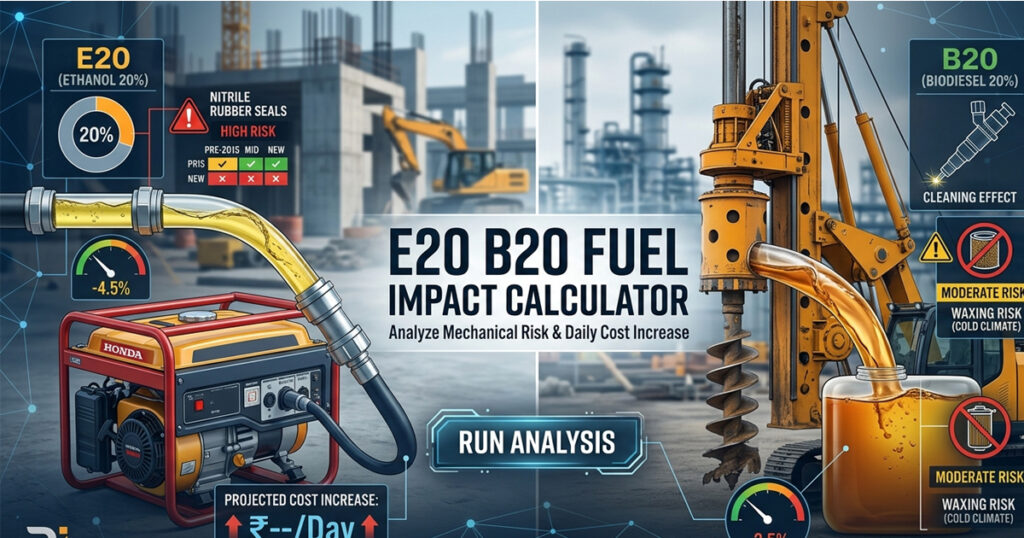
E20 petrol (20% ethanol blend) is growing across the world. For heavy-duty machines and industrial sectors, it shifts to a technical and mechanical divide. Manufacturers of heavy -duty machines are now updating their technology as per the E20 ethanol to keep the engine and machine up to date. However, excavators and piling rigs run on diesel, and the “auxiliary fleet” can lead to the risk of running out. Most machine owners use our e20 and b20 fuel impact calculator and update their machines on time, respectively. From a mechanical engineering perspective, ethanol is not about a fuel additive because it is a solvent and a desiccant.
The Diesel vs Petrol Distinction
Before diving in, it is important to clarify that heavy-duty machinery engines (Diesel) are not affected by E20. Moreover, many fuel additives play a vital role in petrol-powered support equipment on every site, which includes portable generators, water pumps, power trowels, and concrete cutters, is highly influenced by ethanol-related failure.
3 Technical Reasons E20 Challenges Industrial Engines
- Hygroscopy and Phase Separation
Ethanol is hygroscopic, which means it attracts moisture from the air. If petrol remains inactive in a generator tank for more than 3 weeks, the water-ethanol mix separates from the fuel and sits at the bottom of the tank. This phase separation causes the engine to ingest a corrosive water sludge, that could lead to immediate stalls and internal tank rusting.
- Material Degradation (The “Seal Killer”)
Research shows that machine systems or engines built before 2023 are not compatible with the solvent properties of 20% ethanol. While ethanol dissolves plasticisers in rubber and hoses become brittle, and crack carburettor diaphragms lose elasticity.
- The “Cleaning Effect” Clog
Ethanol acts as a powerful cleaner, and it will strip years of varnish and gunk off the inside of an old fuel tank. All loose debris moves directly into the fuel and carburettor jets. Also, the machine ran perfectly on E10, and suddenly, starving for E20 can cause failure.
E20 Compatibility Matrix for Site Equipment
| Equipment Age | Status | Required Engineering Action |
|---|---|---|
| Pre-2015 Models | 🔴 HIGH RISK | Critical. Replace Nitrile hoses/seals with Viton (FKM); clean tank to avoid solvent-clogging. |
| 2015 – 2023 Models | 🟡 MODERATE | Monitor for “sweating” seals. Use ethanol-specific stabilizers for any equipment idle >7 days. |
| 2024 – 2026+ Models | 🟢 COMPATIBLE | Factory-certified. Maintain standard O&M; strictly observe 30-day fuel shelf-life. |
Maintenance Protocol: Protecting Your Auxiliary Fleet
To protect your vehicle, ensure timely inspection and maintenance.
- Switch to Viton: While replacing fuel lines, confirm FKM (Viton) or teflon-lined hoses. It is chemically resistant to high ethanol concentrations.
- Use Fuel Stabilisers: If any machine does not operate on a daily basis, then add an ethanol stabiliser in the fuel tank to prevent phase separation.
- The “Dry Storage” Rule: Drain the carburettor bowl after 15 days. It prevents “varnishing” within tiny fuel jets.
- Monitor Lean Burns: E20 contains more oxygen and causes air-cooled engines to run hotter. Also, check spark plug colours regularly.
Frequently Asked Questions (FAQ)
Q: Can I use E20 in my 10 year old Honda Machine?
Ans: In such situations, older rubber seals will likely fail within months without modifications. It is advised to replace the fuel lines and carburetor gaskets with ethanol-ready versions.
Q: Will E20 reduce the power of my portable generator?
Ans: Technically, yes. E20 has a 3-4% lower energy density than pure petrol. You will also see an increase in fuel consumption to maintain the same power output.
Q: Is there a “Bio-Diesel” equivalent for my main Excavators?
Ans: Yes, the industry is moving towards B20 (20% Biodiesel). While it is different from E20, B20 requires its own set of checks, especially regarding fuel filter plugging in cold weather.