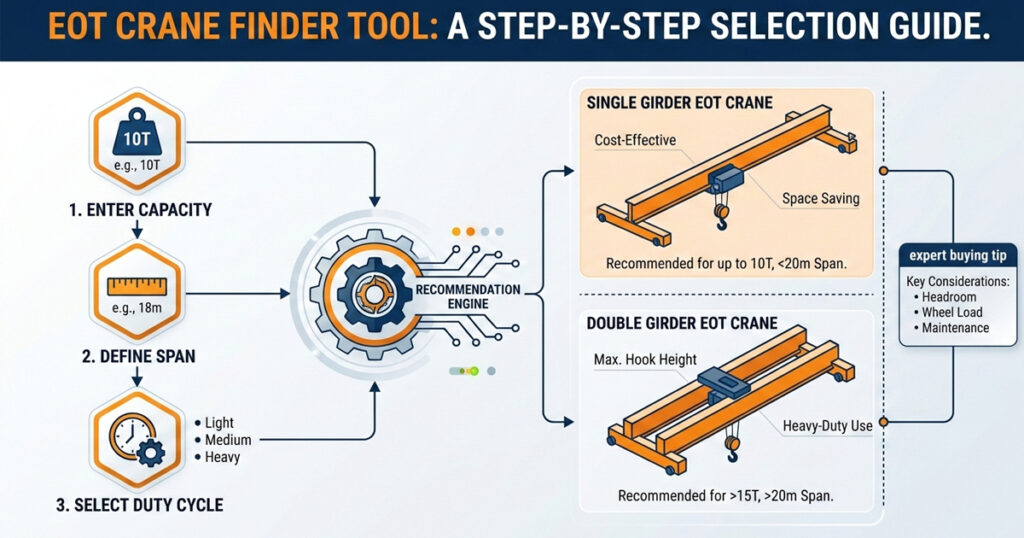
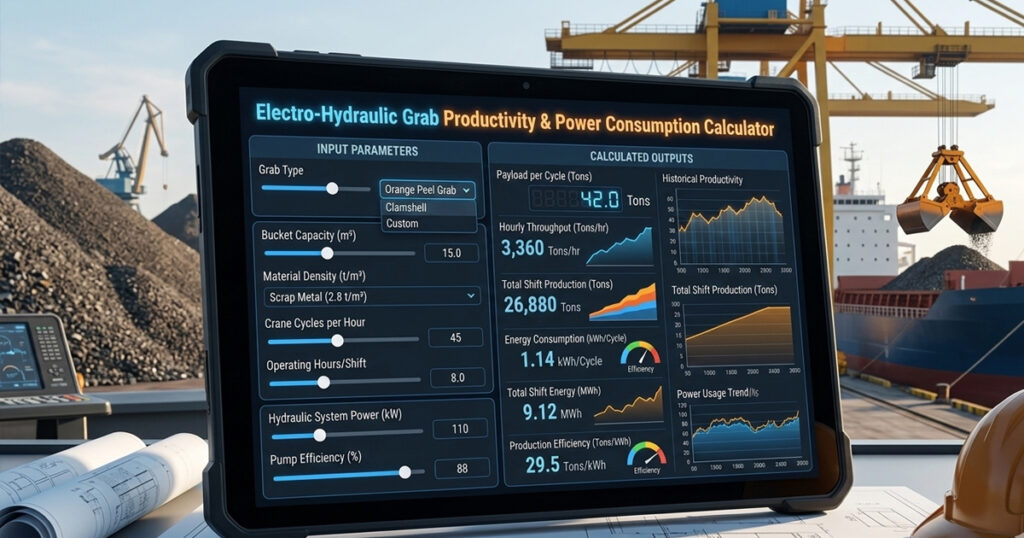
If you are worry about which industrial grab bucket suit to your industry as per material density. Also, consuming more time in calculating the duty cycle, capacity, plant processing fed etc. Then, use our grab bucket tool and calculate the bucket zise and type as per given data.
How to calculate grab bucket capacity
Use this online tool, or understand first purpose of th grab bucket. what grab bucket is handling, what type of material, application etc.
The Throughput Reverse Formula
Min Bucket Volume = (Target TPH × Cycle Time in seconds) ÷ (3,600 × Bulk Density × Fill Factor)
Apply 15–20% buffer on top of a continuous-feed application. A grab system running consistently and no margin for normal operational variation — operator cycle time variance, partial bucket loads on some cycles.
Note: This is a planning tool for early-stage facility design. Actual commissioned throughput should be verified by site acceptance testing.
How to Calculate Grab Bucket Capacity? Material Throughput & Crane SWL Matcher
Analyze Volumetric Efficiency and Payload for Industrial Material Handling
📦 Industrial Load Analysis
Calculated Payload per Grab:
Tons
Total Hourly Throughput:
Tons/Hr
Minimum Required Crane SWL:
Tons
*Safety Calculation: Required SWL = (Material Payload + Dead Weight of Grab). This tool assumes a standard 1:1 weight-to-payload ratio for robust industrial grabs.
Before going for the grab bucket, check out the tool and find the material flow or density to decide the right grabs
Industrial grab buckets come in various types, ranging from single-rope, two-rope, and four-rope mechanical clamshell grabs to self-contained electro-hydraulic and orange peel grabs. They are essential tools in port bulk-material handling, steel mills, mining yards, and waste-to-energy plants. Estimating total material throughput requires considering bucket volume, material properties, duty cycle, and crane winch limitations.
A common design mistake is to assume that a grab bucket always lifts its nominal volume (Vn). In practice, bulk material density (ρ), moisture content, and particle size determine the volume fill factor (FF) and actual cycle productivity.
Hence, the industrial grab bucket capacity calculator is designed to optimise bucket size, estimate duty cycle, and confirm the crane hoist load limits.
What Are the Mathematical Principles of a Grab Bucket?
Calculating material-handling performance involves four core mathematical steps:
+-----------------------------------------------------------------------+
|                         GRAB BUCKET CYCLE                             |
|                                                                       |
|  [Dig & Close] --> [Hoist] --> [Slew/Trolley] --> [Dump] --> [Return] |
+-----------------------------------------------------------------------+
                                  |
                                  v
                    Total Cycle Time (Tc in seconds)
                                  |
                                  v
              Cycles per Hour: Nc = 3600 / Tc
                                  |
                                  v
       Hourly Throughput: Qactual = Nc × P × Eo
1. Payload per Grab Cycle (P)
The weight of bulk material moved per single grab operation depends on the nominal water-level volume (Vn), fill factor (FF), and wet bulk density (ρ).
Formula:
P = Vn × FF × ρ
In simple words: Multiply the grab bucket volume by the fill factor and the material’s bulk density to calculate the weight of material lifted in one cycle.
Where:
Vn: Nominal water-level volume of the grab bucket (m³).
FF: Fill factor.
ρ: Bulk material density (MT/m³).
P: Payload per grab cycle (metric tons).
2. Total Cycle Time (Tc)
The total time for a single digging and dumping cycle is divided into individual operational activities.
In simple words: Add the time taken to dig and close the grab, hoist it, travel to the discharge point, dump the material, return, lower the grab, and allow for operator positioning delays. The total is the complete cycle time in seconds.
Where:
tdig/close: Time required to dig into the material and close the grab.
thoist: Time required to lift the loaded grab.
ttravel,out: Travel time to the discharge point.
tdump/open: Time required to open the grab and discharge the material.
ttravel,return: Travel time back to the loading point.
tlower: Time required to lower the grab into the material.
tmargin: Additional time for positioning, manoeuvring, and operator delays.
Each time component represents the duration, in seconds, of the corresponding grab operation.
3. Theoretical and Actual Hourly Throughput (Q)
Theoretical number of duty cycles per hour (Nc):
Nc = 3600 ÷ Tc
In simple words: Divide 3,600 seconds (one hour) by the time taken for one complete grab cycle to estimate how many cycles can theoretically be completed in an hour.
Theoretical mass throughput (Qtheo in TPH):
Qtheo = Nc × P
Combined formula:
Qtheo = (3600 ÷ Tc) × (Vn × FF × ρ)
In simple words: Multiply the number of cycles per hour by the payload per cycle to calculate the theoretical material throughput in metric tons per hour.
Overall operational efficiency (Eo, typically 75% to 85%) accounts for vessel cleanup, hatch movement, and hopper pauses.
Actual mass throughput:
Qactual = Qtheo × Eo
In simple words: Multiply the theoretical throughput by the operational efficiency factor to estimate the actual material handled per hour.
Where:
Qtheo: Theoretical material throughput (MT/hr).
Qactual: Estimated actual material throughput (MT/hr).
Eo: Operational efficiency factor expressed as a decimal. For example, 82% efficiency is represented as 0.82.
4. Total Crane Hoist Line Load Verification (Whoist)
To avoid crane winch overload, the combined weight of the payload and empty grab shell must remain within the crane’s safe working load (SWL).
Whoist = P + Wdead ≤ SWLcrane
In simple words: Add the weight of the lifted material to the empty grab bucket’s weight. The total must not exceed the crane’s rated safe working load for the applicable configuration.
Where:
Whoist: Combined grab and payload weight, in metric tons, for this simplified check.
P: Payload per grab cycle (metric tons).
Wdead: Empty grab bucket dead weight (metric tons).
SWLcrane: Crane safe working load (metric tons).
Important: This is a simplified load check. Confirm whether the crane’s rated capacity includes the grab attachment and any relevant lifting accessories. Also check the manufacturer’s load chart, reeving arrangement, dynamic effects, and all applicable lifting limits before operation.
Step-by-Step Guide to Calculate Grab Bucket Load Capacity
The estimated actual hourly throughput is approximately 350.95 metric tons per hour.
Step 6: Verify the crane hoist line load.
Formula: Whoist = P + Wdead
Calculation: Whoist = 7.35 + 4.80 = 12.15 MT
Load comparison: 12.15 MT ≤ 15.00 MT
The calculated combined grab and payload weight is below the stated crane rated hook capacity. Confirm the manufacturer’s load chart and all applicable lifting limits before operation.
What Are the Important Operational and Maintenance Guidelines?
1. Avoid Overfilling the Clamshell
Loading the grab with 115% of its heaped capacity can lead to heavy material spillage during hoisting, creating safety concerns and increasing wear on wire ropes and sheaves.
2. Duty Class Selection (FEM/ISO Standards)
High-quality grab buckets are designed according to industrial standards for continuous, heavy-duty cycles.
3. Closing Rope Tension Balance
On four-rope mechanical grabs, confirm equal load distribution between the holding ropes and closing ropes.
Frequently Asked Questions (FAQs)
What Is the Difference Between Water-Level Capacity and Heaped Capacity?
Water-level capacity measures the volume of the grab up to its level rim, while heaped capacity includes the extra material piled above the shell lips.
How Does Material Lump Size Affect Grab Bucket Performance?
Large, irregular lump sizes (150 mm) increase void fractions inside the grab bucket shells, lower the bulk density, and reduce the fill factor to 70–80%.