
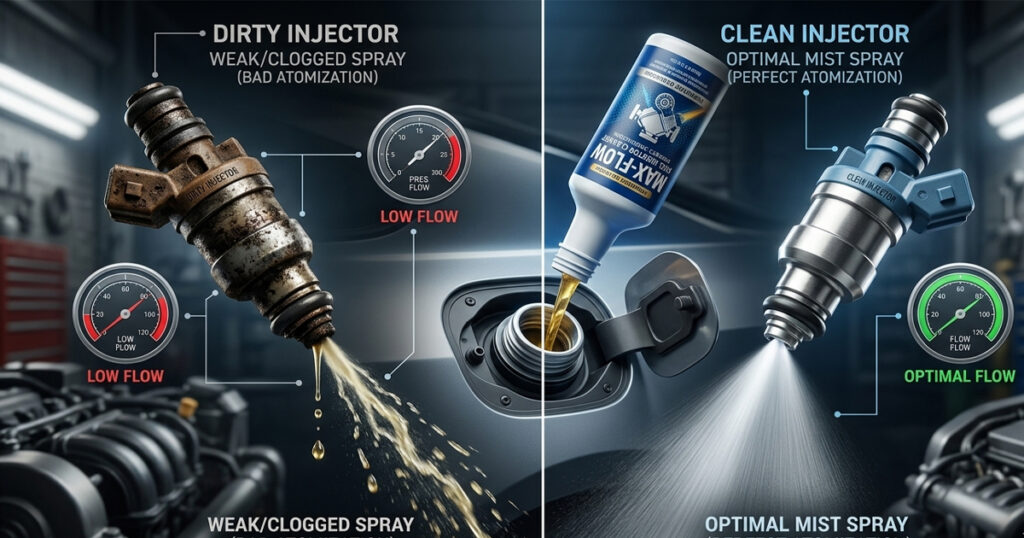
A fuel injector cleaner is a concentrated mixture or blend of solvents and detergents designed to break down and dissolve the carbon deposits and gum that form inside the engine’s fuel system.
This combustion process left unburned hydrocarbons. Therefore, when the hot engine turns off, and the remaining fuel remains at the tip of the injector, it bakes onto the nozzle, creating a hard carbon crust. While modern fuel injectors are engineered to spray a microscopic, highly pressurised fog, even though a microscopic layer of carbon can disrupt the spray pattern, leading to inefficient “drip” rather than a fine mist.
⚡ Quick Answer: A fuel injector cleaner is a chemical solvent, contains Polyetheramine (PEA),hat protects the fuel injector nozzles from the carbon deposits. It restores the fine fuel mist required for efficient combustion, fixing rough idling, vibration, and poor fuel economy.
The Magic Ingredient: PEA
However, all injector cleaners are created differently. The effectiveness of a fuel injector cleaner depends upon its chemical quality. Also, fuel additives are used to enhance the power of engines. While checking for the Polyetheramine (PEA) to ensure the quality of the product. Unlike older solvents like PIB or PBA, which used to burn up in the combustion chamber, PEA is robust enough to survive the heat of the engine. It allows actively scrubbing carbon OFF the injector, intake valves, and piston head as it crosses through the system.
Top 5 Symptoms of Clogged Fuel Injectors
Before using any injector cleaner, Pro Industries specs advices you to check the health of your machine and diagnose the problem. Hence, how do you know if your injectors are clogged? Follow the signs given below:
- Rough Idling: If your vehicle or machine vibrates continuously or “stumbles”, then your engine is likely to need fuel flow.
- Dancing RPM Needle: When the vehicle is parked, the tachometer needle remains steady. Hence, dips in RPMs indicate inconsistent fuel flow.
- Engine Misfires and Hesitation: While pressing the gas pedal and vehicle hesitates before accelerating, a clogged injector may fail to deliver enough fuel.
- Plummeting Fuel Economy: When fuel doesn’t spray correctly, the engine burns inefficiently.
- Check Engine Light: The check engine light on the vehicle dashboard often shows a code.
Petrol vs. Diesel Injector Cleaners: What’s the Difference?
One of the most common mistakes machine operators use the wrong type of cleaner. Petrol and Diesel engines operate under fundamentally different pressures and combustion. Hence, a chemical is needed to remove it.
| Feature | Petrol Injector Cleaners | Diesel Injector Cleaners |
|---|---|---|
| Primary Goal | Remove carbon deposits from intake valves and injector tips. | Remove internal diesel deposits (IDDs) and lubricate the system. |
| Combustion Aid | Octane boosters (prevents engine knock). | Cetane boosters (improves ignition timing in compression engines). |
| Moisture Control | Absorbs minor condensation. | Contains demulsifiers to actively separate water from diesel fuel (critical to prevent rust). |
| Key Ingredients | PEA (Polyetheramine), Naphtha. | Lubricants, Detergents, and Anti-gel additives. |
| System Pressure | Lower pressure (typically 40–70 PSI). | Extreme High Pressure (Common Rail systems run up to 30,000+ PSI). |
Pro tip for heavy machinery: Diesel engines need a higher level of lubricity with ultra-low sulfur (ULSD). If you are running a piling rig, excavator, or heavy-duty machines, it is required to do deep reading into the science of fuel additives and cetane to ensure the protection of fuel pumps.
How to Clean Fuel Injectors (Step-by-Step Guide)
If any type of vehicle is facing mild to moderate symptoms, an in-tank additive is the easy way to clean the injector. Therefore, how to use it properly, guidelines are given below to maximise its cleaning power:
- Run your tank low: Do not use any additives in a full tank. Always use it when the fuel gauge is half or a quarter to ensure a cleaner mix with the incoming rush of fresh fuel.
- Add the cleaner at the Gas Station: When your vehicle is ready for fresh petrol or diesel. It is required to pour the recommended amount into the fuel filler neck.
- Fill the Tank: By adding the cleaner first, the high-pressure flow of the fuel pump automatically mixes the fuel additives and prevent it from settling at the bottom of your fuel tank.
- Drive at highway speeds: If possible, run the vehicle on the highway at a constant speed. Because higher RPMs will force the PEA-rich fuel through the injectors.
What if the Pour-In Cleaner Doesn’t Work?
If you’ve run a high-quality PEA additive via your tank and a misfire persists, the injectors may be completely clogged.
- Pressurised Cleaning Kits: A mechanic will disconnect your fuel pump and attach a forced canister of concentrated solvent to your fuel rail. This process operates when engines are entirely on the cleaner.
- Ultrasonic Cleaning: The injectors need to be removed physically from the engine and placed in an ultrasonic bath while being electronically pulsed open and closed. It can restore the 100% factory conditions.
The Verdict: Are They Worth the Money?
Yes, but need to control your expectations
A $10 bottle of fuel injector cleaner may not fix a blown head gasket, replace a failing spark plug, or repair a mechanically broken fuel pump.
However, if used as preventative maintenance every 5,000 to 10,000 miles, a high-quality cleaner containing PEA will absolutely avoid carbon buildup and restore lost fuel economy to keep your engine running smoother for longer. It is one of the cheapest and most effective forms of preventative maintenance to perform on heavy-duty machinery.
Frequently Asked Questions (FAQs)
Q: How often should I use a fuel injector cleaner?
Ans: It depends upon the model of vehicle; modern vehicles using a high-quality additive once every 5,000 to 10,000 miles is sufficient. Diesel machines operate in dusty environments, and a dedicated diesel treatment might be used with every fill-up.
Q: Can using too much fuel injector cleaner damage my engine?
Ans: Yes, Fuel system cleaners are highly concentrated solvents. An overfilled fuel tank can thin out the fuel too much, also potentially stripping away necessary lubrication and damaging the linings of the fuel seals.
Q: Will fuel injector cleaner clear my check engine light?
Ans: If the check engine light was triggered by a lean fuel mixture caused by a clogged injector, then yes, running a cleaner through the system will resolve the issues and turn the light OFF.
Q: Is there a difference between “Fuel System Cleaner” and “Fuel Injector Cleaner”?
Ans: Yes, fuel injector cleaner is a targeted formula designed to clean the tiny nozzles of the injectors. Also, complete fuel system cleaner is a broader, stronger chemical formula to clean and protect the injectors, intake valves, combustion chambers, and fuel lines, etc.