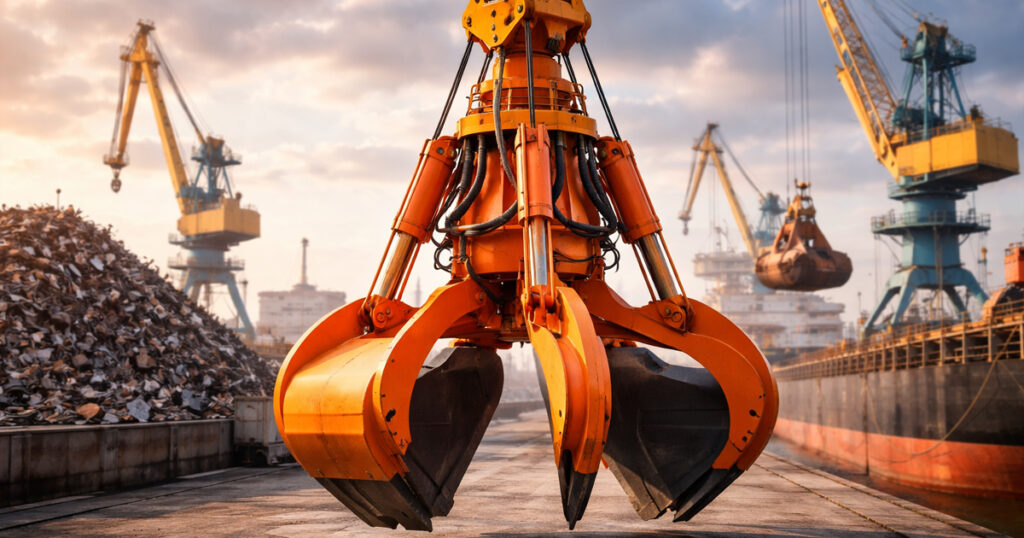
Hydraulic Grab Buckets are powerful attachments without an internal motor. It connected directly to the auxiliary hydraulic lines of a host machine. It allows for extreme precision, 360-degree rotation, and the highest closing power as per its capacity and size.
What is a Hydraulic Grab Bucket?
A hydraulic grab is an attachment that uses high-pressure fluid from the host vehicle to actuate its cylinders. It is designed with a massive engine like a 30-ton excavator and grabs the material through reinforced concrete clay with ease.
Dual-Line System: Usually requires two hydraulic circuits, one for open/ close and one for rotation.
Direct Control: The operator handles the grab bucket and picks up the specific piece of scrap.
Variants and Types of Hydraulic Grab Buckets
| Variant | Design Feature | Best Materials | Primary Application |
|---|---|---|---|
| Hydraulic Clamshell | Symmetrical shells, often with bolted teeth. | Mud, Clay, Soil, Sand. | Deep Foundation & Trenching |
| Hydraulic Orange Peel | 4 to 6 independent high-pressure tines. | Heavy Scrap, Rocks, Boulders. | Demolition & Steel Recycling |
| Sorting/Demolition Grab | Perforated jaws for material “sifting.” | Construction Debris, Bricks. | Site Clearing & Waste Sorting |
| Log/Timber Grab | Interlocking curved tines for round grip. | Tree Trunks, Pipes, Poles. | Forestry & Utility Work |
| Rotating Hydraulic Grab | Features an integrated 360° hydraulic motor. | Any material requiring orientation. | Precision Placement & Loading |
⚙️ Quick Power Estimator
Estimate the grab’s biting force based on your excavator’s pressure.
Pro-Standard Technical Table
| Specification | 5 – 10 Ton Host (Mini/Midi) |
15 – 25 Ton Host (Standard Class) |
30 – 50 Ton Host (Heavy Class) |
|---|---|---|---|
| Volumetric Capacity | 0.2 – 0.5 m³ | 0.6 – 1.2 m³ | 1.5 – 3.0+ m³ |
| Operating Pressure | 200 – 250 Bar | 280 – 320 Bar | 350+ Bar |
| Required Oil Flow | 40 – 80 L/min | 100 – 180 L/min | 200 – 350+ L/min |
| Closing Force (kN) | 25 – 40 kN | 60 – 100 kN | 150+ kN |
| Unladen Weight | 300 – 700 kg | 1,200 – 1,800 kg | 2,500 – 4,500+ kg |
How It Operates (The Hydraulic Circuit)
Connections: Easy to mount to the excavator, loaders arm through a quick coupler.
Pilot Control: It depends on the specification of the machine. Operators use the foot pedal or joystick to send oil via the main control valve (MCV).
Cylinder Actuation: High-pressure oil enters the cylinder bore, pushing the piston to close the jaws or shells.
Rotation: If a grab is attached with a rotator, a different hydraulic motor at the head of the grab enables it to spin.
Technical FAQ
Q: Can I use a 20 – ton grab on 10 0 ton excavtors?
Ans: IN short, NO. Due to hydraulic mismatch, the weight of the grab tip is transmitted to the excavator when the arm is extended. Also, always follow the host class technical table.
Q: What is a check valve in a hydraulic grab?
Ans: It is a safety feature that prevents a hydraulic hose from bursting while the grab is holding a heavy load. Check the valve locks the oil inside cyclinder avoind the shells from charging and discharging the load.
Q: How do I prevent hose damage?
Ans: Ensure the hoses have enough slack to allow for full rotation and use steel-braided spiral wraps