
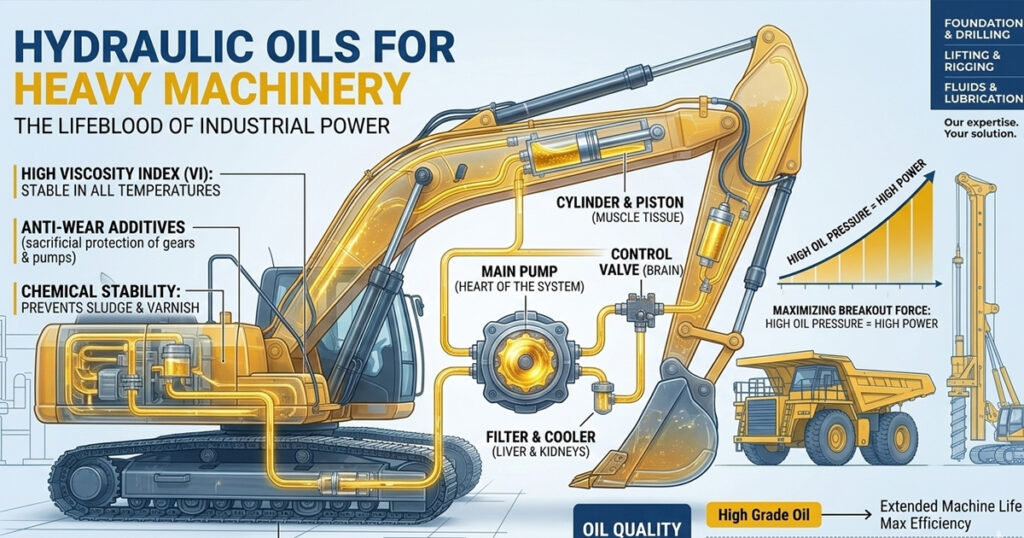
In the class of heavy machinery, hydraulic oils are far more than a lubricant. It is an energy transfer medium. Whether it is the boom of an excavator or the hydra crane’s steering. Therefore, hydraulic fluid is like the fluid muscle that translates engine power into mechanical work and enhances the power of the heavy machinery. Is your machine working under a heavy-duty workflow? Use the Hydraulic Grab Productivity Calculator to check how cycle times affect your oil temperature.
What is hydraulic oil, and how does it work?
While engine oil reduces friction, hydraulic oil operates based on Pascal’s law. Law.
Transmission of Power: Because hydraulic oil is incompressible, pressure is focused on one point and transmitted to another point at zero loss.
Cooling Cycle: Oil circulates through high-pressure valves of a piling rig. It absorbs heat and carries it to the hydraulic cooler to avoid system meltdown.
Sealing Film: It develops a microscopic seal between the piston and the cylinder wall, ensuring that no pressure escapes under heavy loads.
Technical Analysis: Benefits vs. Failure Consequences
| Critical Component | Benefit of High-Grade ISO Oil | Failure Risk (Cheap/Wrong Oil) |
|---|---|---|
| Hydraulic Pump | Anti-Wear (AW) Additives: Protects high-speed vanes from metal-to-metal contact. | Cavitation: Air bubbles implode, “pitting” the metal and destroying the pump. |
| Control Valves | Oxidation Stability: Prevents sludge, keeping precision spools moving freely. | Sticky Valves: Machine becomes “jerky” and dangerous for precision work. |
| Cylinder Seals | Seal Compatibility: Chemicals prevent O-rings from shrinking or cracking. | Internal Leaks: The boom “drifts” down slowly even when controls are neutral. |
| System Heat | High Viscosity Index (VI): Oil maintains thickness even at 100°C. | Total Fade: Oil thins into “water,” leading to total loss of breakout force. |
🌡️ Viscosity Safety Monitor
Check if your oil grade is suitable for your machine’s operating temperature.
Global Standards: ISO VG 46 vs. ISO VG 68
| Machine / Application | Preferred Oil Grade | Engineering Justification |
|---|---|---|
| EOT Cranes (Indoor) | ISO VG 46 | Moderate temperature environments; ensures fast hydraulic response. |
| Excavators / Piling Rigs | ISO VG 68 | High-heat, heavy-duty outdoor work; requires a thicker lubricating film. |
| Borewell Rigs (Cold Climate) | ISO VG 32 | Low-viscosity ("thin") oil for easy pump starts in freezing temperatures. |
| Heavy Industrial Systems | ISO VG 100 | Reserved for extreme high-heat environments like Foundries or Steel Mills. |
Maintenance Strategy for the "Foundation"
Contamination Control: In borewell and hill drilling rigs, dust is the #1 enemy, and even 1% dust in your oils & lubrications acts as sandpaper on hydraulic seals.
Cloudy Oil Test: Hydraulic oil conditions show the quality of it, if it looks like milk or cloudy water has entered there and led to rust and catastrophic failure of grab bucket cylinders.
Technical FAQ: Hydraulic Maintenance
Q: Can I mix different brands of hydraulic oil?
Ans: It is not recommended. While the base oil might be the same, different manufacturers use unique additive packages. Mixing them can lead to a chemical reaction that develops sludge, potentially damaging sensitive hydraulic valves.
Q: How often should I change the hydraulic oil in an Excavator?
Ans: Intervals depend on the working environment. Generally, oil should be replaced every 2,000 to 4,000 operating hours. However, the hydraulic filter is a critical wear item and must be serviced every 500 hours to maintain system health.
Q: What is the difference between Hydraulic Oil and Engine Oil?
Ans: They are engineered for separate functions. Engine oil handles combustion by-products and extreme heat. In contrast, hydraulic oil is designed for high demulsibility (water separation) and rapid air-release to prevent pump cavitation.
Q: Does temperature affect how hydraulics work?
Ans: Yes. High temperatures thin the oil, reducing its viscosity. This is why heavy-duty double-girder EOT cranes in steel mills require a higher ISO viscosity grade than standard workshop single-girder cranes to maintain a protective oil film.