The Productivity Formula
Net TPH = (Volume × Density × Fill Factor × 3600) ÷ Cycle Time × Efficiency
Each variable matters, but fill factor and duty cycle time are two that point underestimate most:
Fill Factor Reference by Material
| Material | Typical Fill Factor | Notes |
|---|---|---|
| Free-flowing sand or grain | 90–100% | Best-case material for grab productivity |
| Coal / fertilizer | 80–92% | Varies with moisture content; wet coal packs better |
| Metal scrap | 50–72% | Wide variation; heavier plate scrap fills better than light sheet |
| Demolition debris / waste | 45–68% | Mixed material sizes; irregular voids reduce fill significantly |
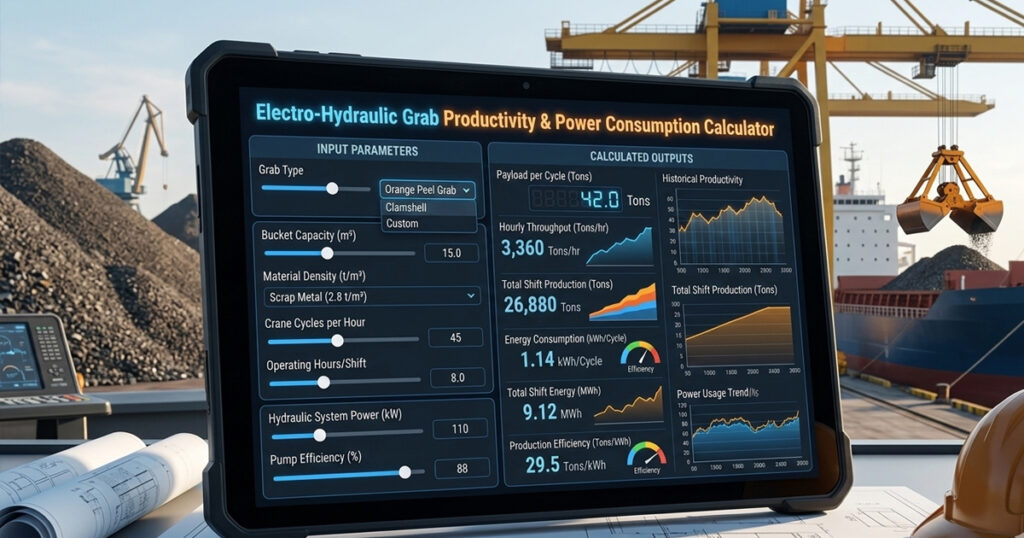
How to Calculate Hydraulic Grab Productivity? Tons Per Hour (TPH) Efficiency Calculator
Optimize Bulk Material Handling Cycle Times and Operational Throughput
📈 Material Handling Logistics Report
| Payload per Single Cycle: | Tons |
| Theoretical Cycles per Hour: | |
| Net Throughput (TPH): | Tons/Hr |
*TPH = (Volume × Density) × (3600 / Cycle Time) × Efficiency.
Check the performance of the hydraulic grab bucket before buying it. We developed this tool after researching.
Hydraulic grabs designed to operate with excavators as attachments, including electro-hydraulic clamshell grabs and orange peel grabs, are primary material-handling tools in ports, bulk material terminals, scrap yards, and dredging operations.
Therefore, analysing net handling capacity in tons per hour (TPH) or cubic meters per hour (m³/hr) requires evaluating more than the grab’s minimum volumetric bucket capacity. It also requires considering material bulk density, hydraulic closing force, cycle time components, and overall operational duty efficiency.
Hence, try our hydraulic grab productivity and material handling calculator to analyse the payload per cycle, total cycle duration, hourly output, and real site throughput under realistic operating conditions.
What Is the Fundamental Mathematical Formula?
To analyse the productivity of hydraulic bulk-handling equipment, follow a four-stage kinematic and volumetric process:
1. Payload per Cycle
   P = Vg × ρ × FF

          ↓

2. Total Cycle Time
   Tc = Sum of all cycle times

          ↓

3. Cycles per Hour
   Nc = 3600 ÷ Tc

          ↓

4. Actual Hourly Throughput
   Qactual = Nc × P × Eo
1. Payload per Cycle (P)
The effective weight of material lifted during a single grab closure is calculated as follows:
Formula:
P = Vg × ρ × FF
Result: Payload per cycle in metric tons (MT).
In simple language: Multiply the grab’s nominal bucket volume by the material’s bulk density and the fill factor to estimate how many metric tons of material the grab carries in one cycle.
Where:
- Vg: Minimum grab bucket volumetric capacity (m³).
- ρ: Material bulk density (MT/m³).
- FF: Grab fill factor, typically between 0.75 and 1.15, depending on material and operating conditions.
2. Total Cycle Time Breakdown (Tc)
The total time needed to complete one full cycle, including slewing, discharging, and returning, is calculated as follows:
Formula:
Tc = tclose + thoist + tslew, loaded + tdump + tslew, empty + tlower + tmargin
Result: Total cycle time in seconds.
In simple language: Add the time required for every operation in one complete grab cycle, from closing the grab around the material to lowering it back into position for the next pickup.
Where:
- tclose: Hydraulic cylinder activation time to close the shells fully into the material.
- thoist and tlower: Vertical hoisting and lowering time.
- tslew, loaded and tslew, empty: Angular rotation time between the digging point and the discharge hopper, with and without a load.
- tdump: Hydraulic opening time to release the material.
- tmargin: Manoeuvring, positioning, and operator reaction time buffer.
3. Cycles per Hour (Nc)
The theoretical number of cycles completed in one operating hour (3,600 seconds) is calculated as follows:
Formula:
Nc = 3600 ÷ Tc
Result: Cycles per hour.
In simple language: Divide 3,600 seconds by the total time taken for one complete cycle. The result is the theoretical number of grab cycles possible in one hour, assuming the cycle time remains constant.
4. Theoretical vs. Actual Throughput (TPH)
Theoretical productivity:
Formula:
Qtheo = Nc × P
Result: Theoretical material throughput in MT/hr.
In simple language: Multiply the number of cycles per hour by the payload carried during each cycle to calculate the theoretical hourly material-handling capacity.
Actual net productivity:
Formula:
Qactual = Qtheo × Eo
Result: Estimated actual material throughput in MT/hr.
In simple language: Multiply the theoretical hourly output by the operational efficiency factor to estimate the material-handling output under real working conditions.
Where:
- Qtheo: Theoretical throughput (MT/hr).
- Qactual: Estimated actual throughput (MT/hr).
- Eo: Operational efficiency factor, expressed as a decimal between 0 and 1. It accounts for practical delays such as hopper alignment, positioning, and interruptions.
Note: The formulas above calculate mass throughput. To estimate volumetric throughput in m³/hr, divide the mass throughput in MT/hr by the material bulk density in MT/m³, using consistent units and the same material density.
Step-by-Step Calculation with an Example
Let’s consider an electro-hydraulic clamshell grab bucket for unloading iron ore fines from a vessel hold into a quayside hopper using a portal harbour crane.
Input Parameters
- Grab Nominal Volume (Vg): 3.50 m³
- Material Bulk Density (ρ): 1.60 MT/m³
- Fill Factor (FF): 0.95 (95% full due to the dense, cohesive nature of the material)
- Operational Efficiency (Eo): 0.80 (80% net job efficiency)
Cycle Time Breakdown
- tclose: 6.0 seconds
- thoist: 8.0 seconds
- tslew, loaded: 12.0 seconds
- tdump: 4.0 seconds
- tslew, empty: 10.0 seconds
- tlower: 6.0 seconds
- tmargin: 4.0 seconds
Step 1: Calculate Payload per Cycle
Use the payload formula:
P = Vg × ρ × FF
Substitute the input values:
P = 3.50 × 1.60 × 0.95
Payload per cycle = 5.32 MT
This means the grab is estimated to carry approximately 5.32 metric tons of iron ore fines during each cycle.
Step 2: Calculate Total Cycle Time
Add the time for all operations:
Tc = 6 + 8 + 12 + 4 + 10 + 6 + 4
Total cycle time = 50 seconds
Step 3: Calculate Cycles per Hour
Divide the number of seconds in one hour by the total cycle time:
Nc = 3600 ÷ 50
Theoretical cycles per hour = 72
Step 4: Calculate Theoretical Throughput
Multiply the payload per cycle by the theoretical cycles per hour:
Qtheo = 72 × 5.32
Theoretical throughput = 383.04 MT/hr
Step 5: Calculate Actual Throughput
Apply the operational efficiency factor of 0.80:
Qactual = 383.04 × 0.80
Estimated actual throughput = 306.43 MT/hr
Therefore, under the stated assumptions, the estimated actual material-handling capacity is approximately 306.43 metric tons per hour. Actual performance will depend on site conditions, material behaviour, operator technique, crane movements, and delays.
What Are the Hydraulic System Considerations and Closing Force Mechanism?
Unlike mechanical rope-operated grabs, where closing force depends upon crane and hoist reeving, hydraulic grabs create the closing force via internal hydraulic cylinders.
The simplified theoretical hydraulic closing-force formula is:
Formula:
Fclose = Phyd × Apiston × Ncyl
Result: Theoretical total cylinder force, subject to the assumptions below.
In simple language: Multiply the hydraulic pressure by the effective piston area to calculate the force produced by one cylinder. Then multiply by the number of cylinders to estimate their combined force.
Where:
- Fclose: Combined theoretical cylinder force (N).
- Phyd: Hydraulic pressure (Pa).
- Apiston: Effective piston area per cylinder (m²).
- Ncyl: Number of cylinders.
Important: This formula estimates the combined cylinder force, not necessarily the final force exerted by the grab shells on the material. Actual shell closing force depends on linkage geometry, cylinder angle, mechanical advantage, friction, and hydraulic losses. For a double-acting cylinder, use the effective area for the relevant direction of movement.
Hydraulic Oil Flow Rate vs. Cycle Speed
The approximate time required to extend or retract the cylinders can be estimated using the total oil volume required and the available pump flow rate:
Formula:
tclose = (Vcylinders, total ÷ Qpump) × 60
Result: Approximate cylinder movement time in seconds when the oil volume is in litres and pump flow is in litres per minute.
In simple language: Divide the total oil volume needed to close the cylinders by the pump’s oil flow per minute, then multiply by 60 to convert the result into seconds.
Where:
- Vcylinders, total: Total oil volume required for the specified cylinder movement (litres).
- Qpump: Available hydraulic pump flow rate (litres/minute).
- tclose: Estimated closing time (seconds).
This is an ideal estimate. Actual cylinder movement time may be longer because of flow restrictions, pressure-dependent flow, simultaneous hydraulic functions, leakage, and control-system settings. Use the appropriate cylinder displacement volume for the closing stroke rather than the cylinder’s total physical volume.
Frequently Asked Questions (FAQs)
What Is the Difference Between an Electro-Hydraulic Grab and a Direct Hydraulic Grab?
A direct hydraulic grab is powered via flexible high-pressure hoses connected to the host excavator’s or crane’s hydraulic power pack. An electro-hydraulic grab has a pump unit on top of the grab frame and needs only an electrical power cable connection from the crane.
How Does Material Particle Size Affect the Grab Fill Factor (FF)?
When fine, uniform materials like dry sand or grain flow into the bucket easily, achieving fill factors up to 1.10. Also, large, interlocking materials with irregular shapes generate large internal voids, dropping fill factors to 0.75–0.85.