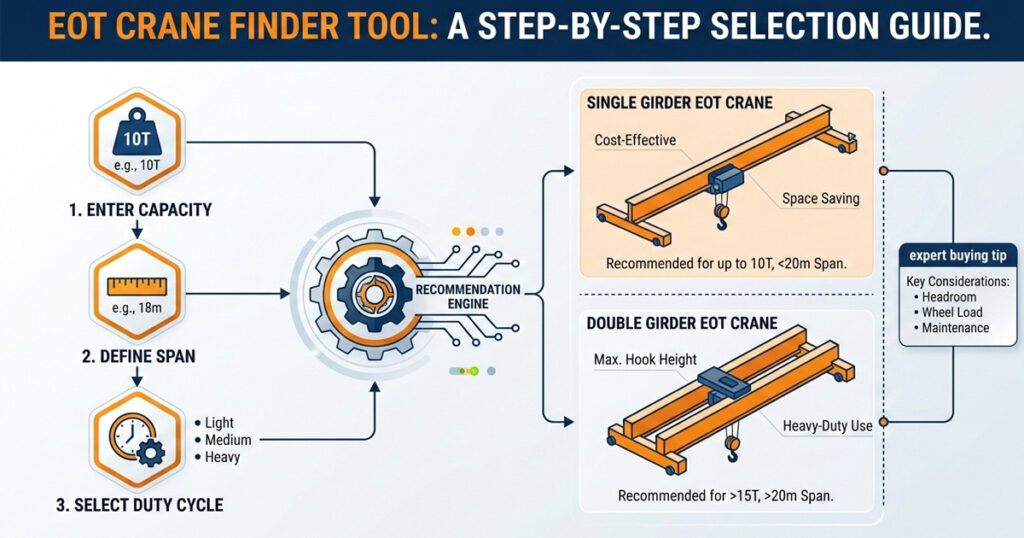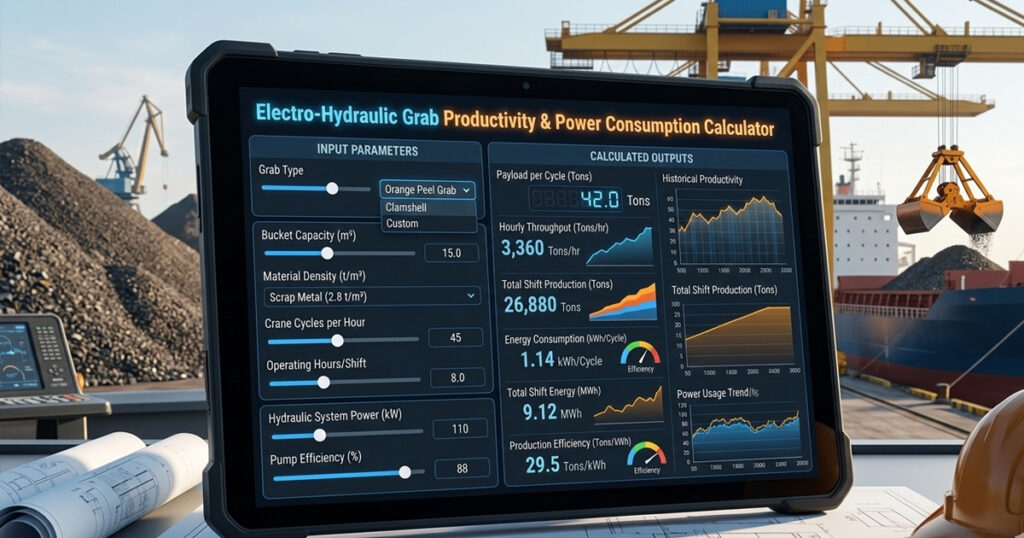
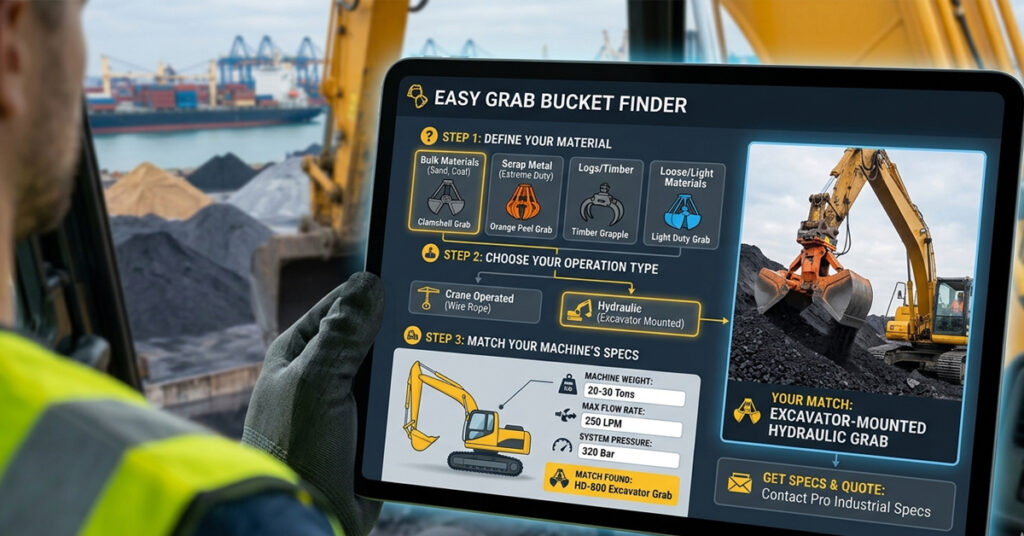
Choosing the right grab bucket is a precise engineering calculation that needs to monitor material density, crane safe working load (SWL), and duty cycle efficiency. Therefore, mismatched data can lead to many operational issues, from dramatically overloading the crane’s motors to operating with inefficient and half-empty buckets.
While many grab bucket operators base their selection on material type, true efficiency requires observing tare weight, fill factors, and the difference between the crane lifting capacity at a minimum radius versus its actual operating radius.
Hence, use our online grab bucket selector calculator below. Input your requirements, including material details, operating mode, required volume, and crane SWL. This online tool provides the exact grab bucket specifications required to safely maximize your duty cycle.
Grab Bucket Selector
Expert Engineering Analysis for Industrial Material Handling
Use the calculator to determine the appropriate grab bucket specifications based on your material, operating conditions, required volume, and crane SWL.
The Four Variables That Drive Grab Selection
To understand the tool output, it is necessary to look at the four variables that dictate grab bucket sizing:
1. Material Bulk Density
Material density is the foundational variable in every grab bucket calculation. Sand and gravel at 1.6 t/m³ operate entirely separately from light scrap material at 0.8 t/m³ or heavy plate scrap at 2.5 t/m³.
For example, a 10 m³ grab bucket designed for handling coal at 0.85 t/m³ will not be useful if iron ore fines at 2.2 t/m³ are being handled. Therefore, you must audit the size of the bucket for heavy-duty loads.
2. Operation Mode and Tare Weight
The mechanical operation type drastically changes the empty weight of the grab bucket, which consumes the crane’s available SWL.
- Mechanical Wire Rope Grabs: Lightweight grabs or dead-weight grabs require a crane equipped with multiple rope drums, from single-rope, two-rope, and four-rope cranes.
- Electro-Hydraulic Grabs: These are powered by electricity, a motor, pump, and valve body. While they offer massive opening and closing force, they carry less payload per cycle.
- Hydraulic Grabs: These are designed to operate with excavators or material handlers, with an onboard cylinder and operational 360-degree rotation and linkage specifications.
3. Required Volume vs. Crane SWL
This is the primary safety check and monitors the volume multiplied by the material density and the fill factor. It must not be more than the crane’s available lifting capacity once the grab’s tare weight is subtracted.
4. Material Fill Factor
This fill factor shows how much of the grab bucket’s geometric volume is filled with material during the cycle.
- Free-flowing granular material: Materials like dry sand and grain easily slide into the bucket, yielding a 90–100% fill factor.
- Interlocking or irregular materials: Materials like scrap metal or large boulders leave air gaps, yielding a much lower 50–66% fill factor.
The Core Selection Formula & Dynamic Loading
When analyzing the grab manually, engineers use the following formula:
Safe Payload per Cycle = (Crane SWL × 0.75–0.85) − Grab Tare Weight
Understanding the 0.75–0.85 Safety Factor
When a heavy hydraulic grab closes around the material and the crane lifts upward, dynamic impact loading increases the static weight. Therefore, most OEM grab factors provide a critical margin between a safe, efficient lift and an overload trip that shuts down operations.
Step-by-Step Calculation Example
Assume you have a harbor crane with 25-ton SWL and you need to move coal with a density of 0.85 t/m³ using an electro-hydraulic grab with a weight of 8 tons.
- Calculate Available Lifting Capacity: 25 tons SWL × 0.80 = 20-ton safe limit.
- Calculate Maximum Payload: 20 tons limit − 8 tons = 12 tons maximum payload.
- Calculate Maximum Bucket Volume: 12 tons payload ÷ 0.85 t/m³ = 14.1 m³ maximum bucket volume. If you are choosing a grab bucket larger than 14.1 m³ for the particular setup, you risk overloading the crane during dynamic hoisting.
Jaw Configuration by Material
| Material | Recommended Jaw Type | Typical Fill Factor |
|---|---|---|
| Sand, gravel, grain | 2-jaw clamshell | 88–100% |
| Coal, fertilizer | 2-jaw clamshell (wire rope or hydraulic) | 80–92% |
| Metal scrap | 4–5 petal hydraulic | 50–72% |
| Municipal waste / demolition debris | 4-petal orange-peel hydraulic | 45–68% |
FAQs
Does Operating Radius Affect Grab Capacity?
Yes. A crane’s SWL is not static; it decreases as the boom radius increases. You must analyze the maximum operating radius reached during the cycle, not the crane’s absolute maximum capacity.