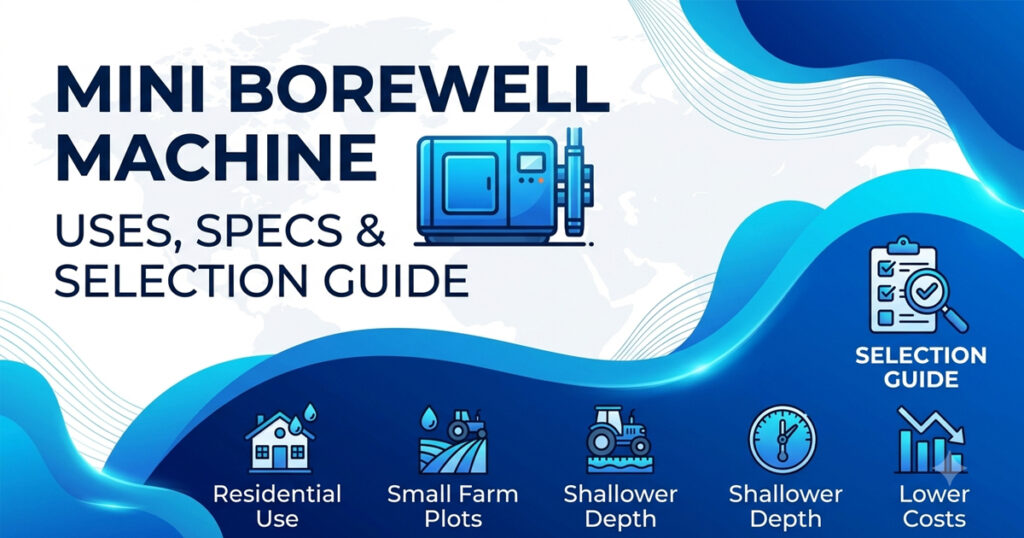
A mini borewell machine is designed to operate on small or limited water projects. It is ideal for residential properties, small agricultural plots, and sites where setting up a full-size borewell drilling machine is either unnecessary or physically impossible.
What Distinguishes a Mini Borewell Machine?
Mini borewell machines are built with a smaller compressor and rotary drive than full-size piling rigs. As a result, they offer reduced maximum drilling depths and bore diameters compared to commercial-scale equipment. However, the smaller footprint and lighter transport weight of a mini borewell machine allow for easy transportation to narrow sites, small plots, and farm lands—significantly reducing overall operating costs.
When a Mini Borewell Machine Is the Right Choice
- Residential and small agricultural wells: Ideal for projects where the required depth and diameter fall within the machine’s capacity, making a full-scale rig unnecessary.
- Restricted access sites: Perfect for locations where large machines cannot navigate, such as narrow residential lanes or tight farm access tracks.
- Lower-budget projects: Economical choice offering lower operating and rental costs compared to commercial-scale equipment.
- Shallower depth requirements: Suitable when the target water table lies within the mini rig’s drilling depth range.
Mini Borewell Machine vs. Standard Borewell Rig
| Factor | Mini Borewell Machine | Standard Borewell Rig |
|---|---|---|
| Typical Drilling Depth | Shallower maximum depth | Greater depth capability |
| Bore Diameter | Smaller typical diameter | Larger diameter range |
| Compressor Size | Smaller (lower CFM output) | Larger (higher CFM for harder rock strata) |
| Site Access Needs | Minimal (fits narrow access paths) | Requires wide access roads and turning radius |
| Typical Use | Residential, small agricultural plots | Commercial, industrial, deep municipal wells |
Note: Exact depth and diameter capabilities vary significantly between manufacturers. Always verify against a specific machine’s specification sheet before selecting equipment for a target depth.
Common Applications
- Residential water supply wells
- Small-scale agricultural and farm irrigation borewells
- Rural property development
- Work sites with narrow or restricted vehicle access
- Cost-sensitive or budget-constrained projects
How to Choose the Right Mini Borewell Machine
Before selecting a machine, evaluate your local geology and target drilling depth. Because a mini rig has a reduced compressor capacity, it is better suited for softer soil formations and shallower targets rather than hard rock or deep municipal drilling. Always ensure the machine’s CFM (Cubic Feet per Minute) and PSI (Pounds per Square Inch) outputs are sufficient for your site’s soil and rock conditions before starting work.
Frequently Asked Questions (FAQs)
The maximum depth depends on the manufacturer and model, but it is generally shallower than commercial-scale rigs. Always confirm the specific machine’s depth rating against your project’s target depth before making a selection.
Mini rigs generally have lower compressor CFM/PSI output compared to large-scale rigs. For hard rock conditions, check whether the specific machine’s compressor ratings are adequate, or consider upgrading to a standard capacity rig.
Mini rigs consume less fuel and have significantly lower overall operating costs. Their smaller engines and compressors make them far more economical for projects that fall within their depth and diameter capabilities.
Yes, easy access to tight spaces is one of the primary advantages of a mini rig. Its compact design allows it to pass through narrow residential lanes and small farm access points where a full-sized commercial rig cannot fit.