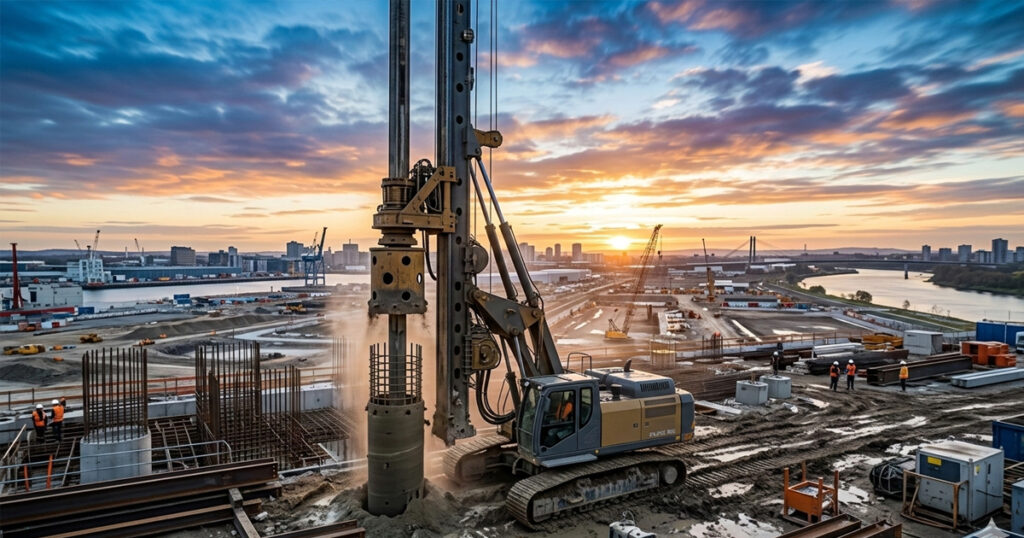
Most of the time, contractors use a rig that does not match the ground conditions. This causes failures during boring and results in delays, stuck drill strings, and other breakdowns on-site. This online piling rig calculator lets you input your project data in advance to get information about torque, bore diameter, target depth, and formation type, and it recommends a rig class.
Piling Rig Selection Optimizer & Torque Requirement Tool
Match Project Specs to the Ideal Hydraulic Drilling Rig
📋 Engineering Recommendation
Estimated Required Torque: kNm
Recommended Rig Class:
Kelly Bar Type:
Rig Classification by Torque Output
| Rig Class | Max Torque | Typical Application |
|---|---|---|
| Compact / Mini | 30–80 kNm | Micro-piling, restricted access, soft soil up to 600 mm |
| Small | 80–150 kNm | Shallow piles, soft-medium clay, up to 600 mm diameter |
| Medium | 150–250 kNm | Standard building foundations, 600–1,000 mm, mixed formations |
| Large | 250–400 kNm | Bridge piers, industrial plants, hard gravel, 1,000–1,500 mm |
| Heavy | 400–600 kNm | Weathered rock, large diameter 1,200–2,000 mm |
| Super Heavy | 600+ kNm | Hard rock, marine piling, diameter 2,000 mm+ |
The Formula This Calculator Applies
Required Torque (kNm) ≈ π/4 × D² (m) × Soil Resistance Factor × Depth Correction.
Torque demand does not scale linearly with diameter. Going from 600 mm to 1,200 mm does not simply double the requirement; it roughly quadruples it, since torque scales with the diameter squared.
Real-World Scenario: How the Calculator Arrives at Its Recommendation
Let's look at a real-world scenario to analyze how the calculator arrives at its recommendation. Let's imagine you are a contractor drilling a 1,000 mm diameter pile to a target depth of 25 meters in weathered rock.
- Diameter Factor: A 1,000 mm (1-meter) bore is large and immediately pushes the required torque beyond the capacity of smaller rigs.
- Soil Resistance: Rock provides high resistance.
- Depth Factor: At 25 meters, the friction on the Kelly bar and auger is significant.
When you input these metrics into the calculator, the squared diameter, alongside the high rock resistance factor, will provide an estimated torque requirement of 280–350 kNm.
Right Classification by Torque Output
This helps civil contractors, foundation engineers, and piling rig rental agencies understand the classification of a rig.
-
Compact: 30–80 kNm Maximum Torque
Designed for micropiling, restricted access, and soft soil, with bore diameters of up to 600 mm.
-
Small: 80–150 kNm Maximum Torque
Suitable for shallow piles and soft to medium clay, with bore diameters of up to 600 mm.
-
Medium: 150–250 kNm Maximum Torque
Designed for building foundations with 600–1,000 mm bores and mixed formations.
-
Large: 250–400 kNm Maximum Torque
Suitable for bridge piers, industrial plants, hard gravel, and bore diameters of 1,000–1,500 mm.
-
Heavy: 400–600 kNm Maximum Torque
Designed for weathered rock and large-diameter bores ranging from 1,200–2,000 mm.
-
Super Heavy: 600+ kNm Maximum Torque
Suitable for hard rock, marine piling, and bore diameters of 2,000 mm and above.
Friction vs. Interlocking Kelly Bar
Our calculator offers a Kelly bar recommendation.
-
Friction Kelly Bars
First of all, these are used in soft soils and loose sands. They rely on friction between the telescopic sections to transfer torque.
-
Interlocking Kelly Bars
These are used for dense gravel, weathered rock, and hard rock, allowing the rig to push downward while rotating.
FAQs
What Happens If My Piling Rig Does Not Have Enough Torque?
If a rig is not sufficient for the soil conditions, the auger will be unable to penetrate the ground. This forces the operator to repeatedly reverse and restart, leading to overheating, mechanical wear, and a high risk of breaking the drill string underground.
Can I Use a Heavy Rig for a Small-Diameter Pile?
Yes, but it is highly inefficient and cost-prohibitive. Heavy rigs need more fuel, more power, and wider access roads.
The above selector tool would help the Civil Contractors, Foundation Engineers, and Piling Rig Rental Agencies to select the suitable rig machine as per thier requirements.