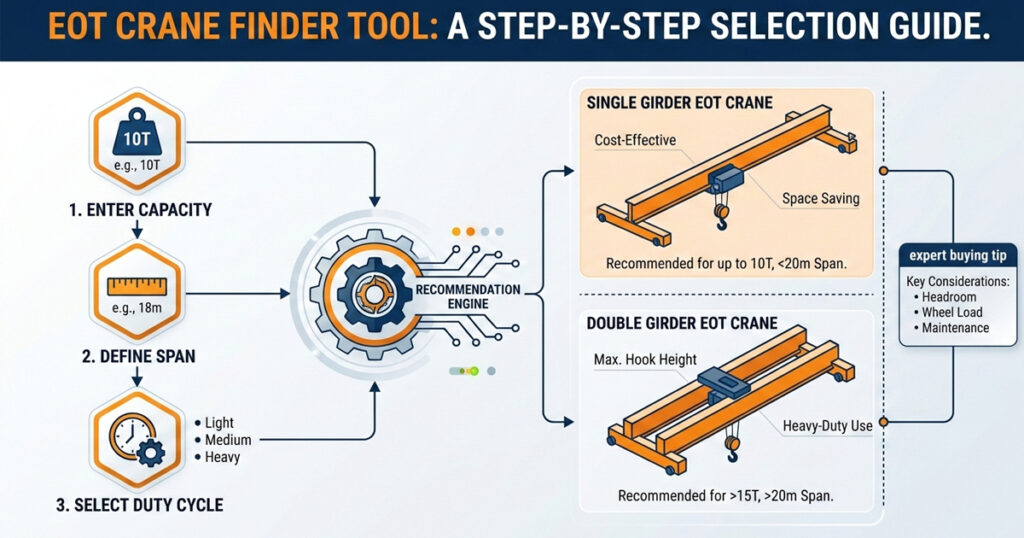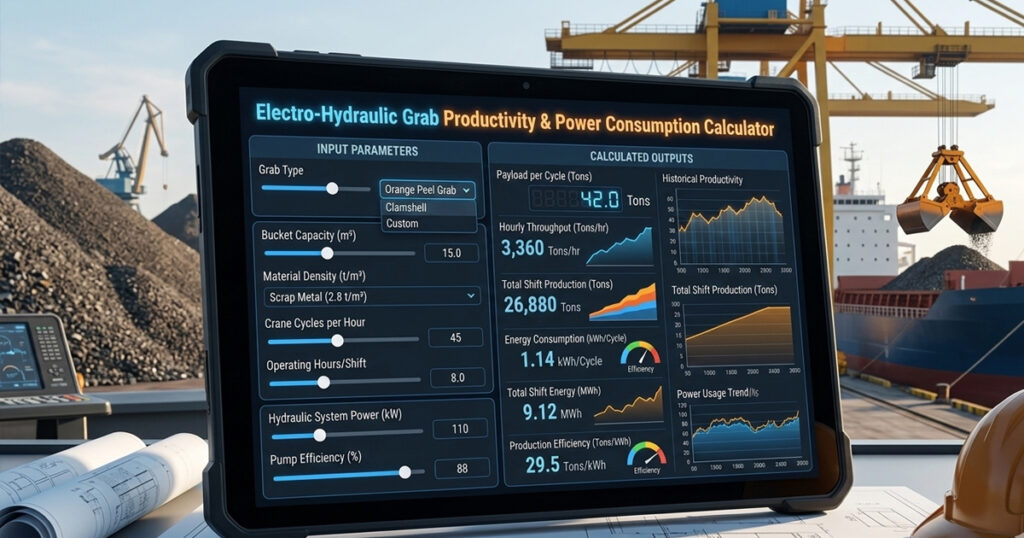
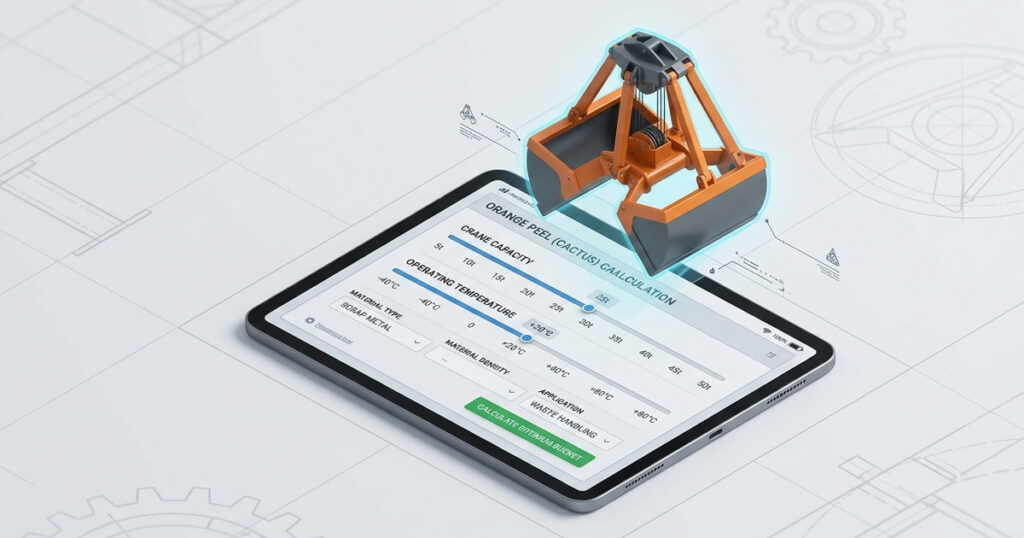
This online Grab Bucket Selector calculator helps the industries to chose the right , and suitable grab bucket as per their material and requirements. Calculate the accurately load-checked engineering recommendation with capacity calculation, use the full selector.
Grab-to-Application compatibility
| Application | Typical Grab Type | Common Size Range |
|---|---|---|
| Port coal / fertilizer unloading | Mechanical wire rope clamshell | 4–16 m³ |
| Steel scrap yard | Hydraulic multi-petal | 0.5–4 m³ |
| Ship unloader (port terminal) | Electro-hydraulic clamshell | 6–20 m³ |
| Construction demolition clearing | Hydraulic orange-peel or clamshell | 0.3–2 m³ |
| Waste-to-energy facility | Hydraulic orange-peel | 2–8 m³ |
How to Size a Grab Bucket? Crane SWL vs. Material Density & Volume Calculator
Optimize Material Handling Throughput and Crane Safety
📦 Grab Selection Analytics
| Recommended Bucket Volume: | m³ |
| Net Material Payload: | Tons |
| Selection Status: |
Our tool provides detailed information on industrial grab bucket selection according to your facility.
Grab bucket designed to handle all types of material but selecting the right grab bucket as per requirement is difficult. Hence, grab bucket attached and operate with port cranes, overhead cranes, excavator. While, using a oversized model of grab can break down cranes overload trips, rapid hear bucket failure, and boom or gantry issues occurs. Also, undersized model reduce material output, prolongs vessel turnaround times, and operational costs.
Therefore, exact match of the grab bucket require calculation of material density, volume vs crane SWL, operating mechanisms, tare weight and material Fill Factor.
Use our grab bucket finder calculator and input crane load capacity, material profile, operational parameters and get the grab bucket as per your industry circumstances. also, talk to the grab bucket Manufactures before any final conclusion.
For a broader understanding of grab bucket selection, types, applications, and material-handling considerations, see our industrial grab buckets guide.
Engineering Dynamics of Grab Selection
when a crane hoists hold load-carrying grab bucket, the entire force exerted on the hoist wire ropes or hydraulic jib exceeds the static mass of bulk material. Size of grab bucket comes for four operational variables:
1. Material Bulk Density (ρ)
Bulk material densities range from 0.75t/m3 to 2.40t/m3. A bucket size for coal handling overload the crane if used for heavy mineral ores.
2. Grab Dead Weight/ Tare Mass (Wtare)
The unladen mass of the grab parts like grab shell, hydraulic cylinders, motor-pump group, or mechanical sheaves. Also, electro hydraulic Grab Bucket provides higher closing force but reduce the payload capacity.
3. Volumetric Fill Factor (φ)
The ratio of the actual volume of material analysed per cycle relative to bucket rated geometry capacity (Vrated). While, material like granular achieve fill factor from 90 to 100 while, other like irregular shape scrap material yield lower rated from 45 to 65.
4. Dynamic Loading Coefficient (Kd)
Dynamic forces occurs when rapid acceleration, closing impact, and slewing need a safety margin applied to the crane’s safe working load (SWL). Also, standard duty cycle factor of 0.75 to 0.85 to the static SWL rating.
The Maximum Permissible Geometric Volume
The maximum permissible geometric volume (Vrated) of the grab bucket is determined by:
Safe Lifting Capacity (Qsafe) = Crane SWL × Kd
Maximum Allowable Payload (Pmax) = Qsafe − Wtare
Recommended Bucket Volume (Vrated) = Pmax ÷ (ρ × φ)
Step-by-Step Selection Example
Let’s take the example for unloading iron ore fines at port terminal.
Operation Inputs
- Crane Rated SWL: 16.0 Metric Tons
- Material: Iron Ore Fines (ρ = 2.40 t/m3)
- Operating Mode: Electro-Hydraulic 2-Jaw Clamshell Grab
- Grab Tare Weight (Wtare): 6.50 Metric Tons
- Dynamic Safety Factor (Kd): 0.80
- Estimated Fill Factor (φ): 0.90 (90%)
Step 1: Calculate Safe Dynamic Lifting Capacity (Qsafe)
Qsafe = 16.0 Tons × 0.80 = 12.80 Tons
Step 2: Calculate Maximum Allowable Payload (Pmax)
Pmax = 12.80 Tons − 6.50 Tons (Tare Weight) = 6.30 Tons
Step 3: Calculate Maximum Recommended Geometric Bucket Volume (Vrated)
Vrated = 6.30 Tons ÷ (2.40 t/m3 × 0.90) = 2.92 m3
Selection Verdict: Select a 2.8 m3 to 3.0 m3 Electro-Hydraulic Clamshell Grab engineered with high-wear AR400/HARDOX steel lip plates.
Grab Drive Mechanics Compared
1. Mechanical Wire Rope Grabs (2-Rope/4-Rope)
Pros: Very less tare weight, zero electrical equipments exposed to difficult environments, fast operating cycle times.
Cons: Supported by multi drum winches on the crane, and closing force rely upon the crane hoists.
2. Electro Hydraulic Grabs
Pros: Develops huge self-contained closing force through onboard motor pump hydraulics operate on single hook standard cranes.
Cons: Heavy tare weight reduces the payload and need cable reeling drums for electrical power delivery.
3. Radio Remote Control (RRC) Touchdown Grabs
Pros: Operates on single hook cranes without electric power and open mid air wireless remote capability.
Cons: Gravity assisted single operating closing mechanism yields lower digging force in high density compact material.
FAQs
How Do Spill Plates or Kick Plates Affect Grab Volume?
Ans: Spill plates are designed with fitted inside clamshell shells to reduce the geometric capacity. Also, it operates to use the similar heavy weight exceeding the crane’s SWL limits.