In 2026, the heavy-duty material handling industry landscape is shifting because of fluctuating fuel prices across the global market. For a 20-ton excavator, almost 20% difference in fuel burn can translate to savings. Most of the heavy machines utilize the minimum diesel and deliver s the hybrid tech, AI-loading sensing, and Tier 5 engine standards.
Top 5 Fuel-Efficient Machines for 2026
- The Hybrid Master: Komatsu HB365LC-3 Excavator
The HB365LC-3 is a unique machine model for hybrid efficiency. Unlike traditional systems, this excavator uses an electric motor swing motor-generator. Also, it saves energy during the swing brake and stores it. It uses an ultra-capacitor to assist engine acceleration. Best use for high-duty-cycle excavation and deep trenching, and is effective in consuming fuel 25% less than other non-hybrid models.
- The Smart Specialist: Caterpillar 320 Next Gen
CAT has built-in smart feature model technology that automatically matches engine and hydraulic power to the workflow conditions. It essentially thinks for the operator to avoid over-revving. Also, machines reduce the 20% fuel reduction through integrated 2D grade control. And deliver high performance in construction and high-precision grading.
- The Hydrostatic Champion: Liebherr PR 736 Generation 8 Dozer
Liebherr’s hydrostatic drive system supports the engine to operate at a constant, low RPM regardless of travel speed. This reduces the effects of the traditional gearbox and torque converter, which is the primary source of energy loss. It operates in heavy duty activites and clearing the ground also reduces the fuel cost.
- The Electric Revolutionary: JCB 19C-1E Mini Excavator
It delivers similar power and workflow performance as a diesel counterpart and is supported by a lithium-ion battery, and it requires no fuel cost. Also, the charging cost of the machine is 1/5th compared to diesel operation and delivers the best performance in indoor demolition, emission-sensitive zones and urban utility.
- The Precision Loader: Volvo L120H with OptiShift
Volvo’s OptiShift technology offers the combined reverse by braking (RBB) feature with a torque converter with lock-up. It eliminates power losses in the torque converter during the loading cycle. Also, improve the 18% fuel consumption during the short-period cycle in quarry operations and aggregate handling.
Engineering Insights: Variables that Impact Fuel Burn
To optimise your hourly cost, you must look beyond the machine specification sheet.
- The Idle Factor: Statistics data show that the average heavy machine idles for 30% to 40% of its operating time. It prevents and avoids the mechanical or maintenance time upto 10%.
- Hydraulic Attachment: It is essential to match the attachment as per the capacity and operation of the machine. For example, using an unoptimized grab bucket forces the hydraulic pump to lift more and increases the risk of a fault. While an accurate match of attachment helps to increase the power of the excavator and save the time up to 2 hours.
- Soil Bearing & Rolling Resistance: Operating on soft clay increases the energy required to move. Also, utilising a Rough Terrain Crane offers stability principles to reduce the strain on the carrier’s drivetrain.
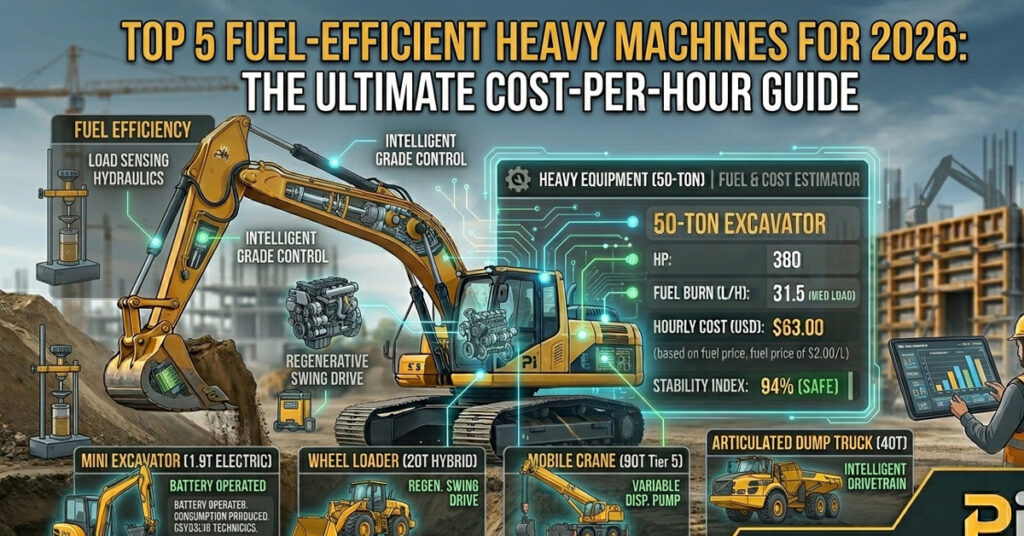
Hourly Fuel Consumption & Cost Estimator
Use the tool to calculate your project fuel cost. Here, enter your machine’s horsepower and local fuel price to see the statistics of load factors on daily operation.
Hourly Fuel & Cost Estimator
Industrial ROI Tool • 2026 Edition
Fuel Management: Frequently Asked Questions
Disclaimer:
All brand names, logos, and trademarks mentioned in this article (including Caterpillar, Komatsu, Liebherr, JCB, and Volvo) are the property of their respective owners. Pro Industrial Specs is an independent technical resource. The use of these names is for informational and “nominative fair use” purposes only to identify specific equipment. This website is not affiliated with, sponsored by, or endorsed by the manufacturers mentioned.