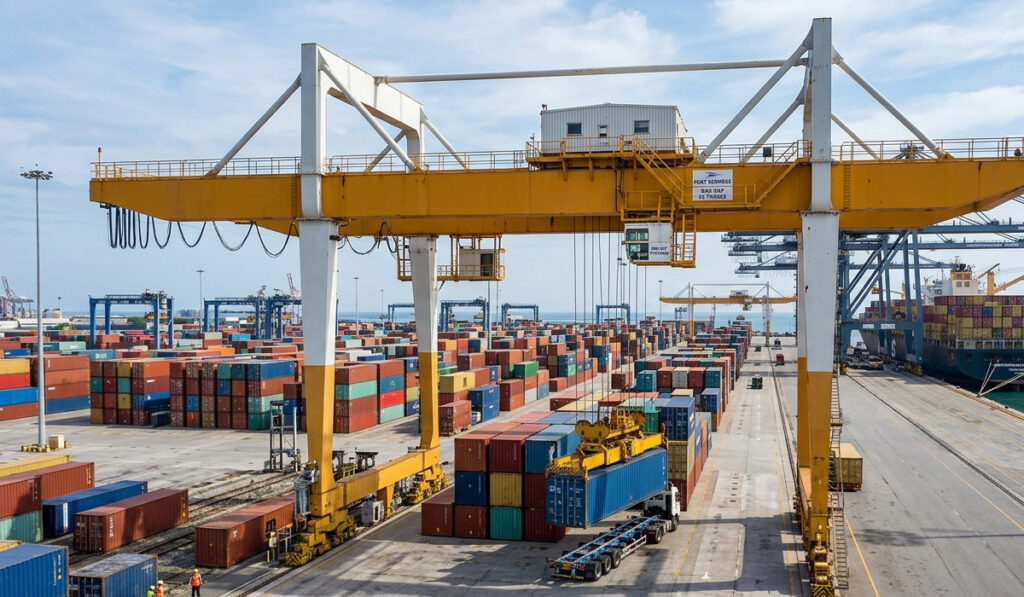
A gantry crane, also known as a Goliath crane, is a freestanding lifting structure that operates without an overhead building framework to move material from one place to another. Unlike an EOT crane, which runs on fixed rails attached to an existing building structure, a gantry crane features its own supporting legs that run on rail tracks on the ground. Gantry cranes come in many types to suit various industrial demands. They perform well in outdoor yards, shipping facilities, and ports, requiring open space for operation.
How a Gantry Crane Works
A gantry crane is supported by two or more vertical legs and a horizontal bridge girder to handle heavy-duty materials. A hoist and trolley travel along the bridge girder, providing both lengthwise and crosswise travel. The gantry crane operates without requiring any existing building infrastructure, as the crane itself is entirely self-supporting.
Gantry Crane Types
- Full gantry crane:
Designed to lift heavy-duty materials, a full gantry crane is supported by legs on both sides of the bridge that run on ground-level rails. It is commonly used in outdoor yards, shipping facilities, and container-handling sites.
- Semi-gantry crane:
This crane is supported by a leg running on a ground-level rail on one side, while the other side runs on an elevated rail mounted on a building wall. This hybrid design is useful when only one side of the workstation has an existing building support structure.
- Single girder gantry crane:
Lightweight gantry cranes operate with a single bridge girder and are generally designed to lift lighter loads up to 15 tons across shorter spans, providing a cost-effective option where headroom is limited.
- Double girder gantry crane:
Designed for heavy-duty applications, this configuration features two parallel bridge girders to support heavier loads and longer spans. It is used for the largest gantry cranes, including high-capacity units in port container handling.
- Rubber-tyred gantry crane (RTG): A mobile crane mounted on rubber tyres instead of fixed rails, capable of moving freely across storage yards. RTGs are standard equipment for container handling worldwide, valued for their mobility.
Gantry Crane Capacity and Specifications
Gantry crane features and capacity ranges depend on the application—ranging from workshop units in the 0.5-to-5-ton range and mid-size yard cranes in the 10–50-ton range, up to the largest port and shipbuilding gantry cranes exceeding several hundred tons.
| Class | Typical Capacity | Typical Use |
|---|---|---|
| Light/workshop | 0.5–5 tons | Small fabrication shops, maintenance bays |
| Medium/yard | 5–30 tons | Warehouse yards, general industrial lifting |
| Heavy | 30–100 tons | Precast concrete yards, heavy equipment assembly |
| Port/shipbuilding | 100+ tons | Container handling, shipyard block lifting |
(Note: These are general industry class ranges for orientation—confirm exact capacity and span specifications against a specific manufacturer’s certified load chart before procurement.)
Gantry Crane vs. Bridge Crane vs. EOT Crane
This is one of the most commonly searched comparisons, and the key difference comes down to structural support:
- Gantry crane: Self-supporting and operates on its own ground-level track. It is best suited for outdoor yards where a building structure is not available.
- Bridge crane / EOT crane: Operates on rails mounted to an existing building’s structural steel, without ground-level supporting legs. The building must be engineered to support the crane’s load, but this setup keeps the floor space completely clear. If a facility already has the structure to carry an overhead crane, an EOT or bridge crane is ideal. They are available in single and double girder designs depending on industrial requirements, and many manufacturers also offer semi- and fully automatic models for specialized facilities like waste plants.
Gantry Crane Assembly and Installation
Gantry cranes offer the advantage of being faster to install than building-mounted EOT cranes because there is no need to reinforce or modify existing structural steel—the crane’s own legs and base bear the entire weight. However, ground-level rails require a properly engineered foundation to distribute wheel loads, while rubber-tyred gantry cranes require a level, adequately compacted yard surface.
Common Applications
- Shipping ports and container yards (primarily rubber-tyred gantry cranes)
- Shipbuilding and heavy fabrication yards
- Precast concrete production yards
- Outdoor equipment assembly and maintenance areas
- Workshops and fabrication shops without overhead crane infrastructure
How to Choose the Right Gantry Crane
First, inspect your site, the materials being handled, and the type of operation required. Next, contact manufacturers to schedule an on-site consultation. Select a single vs. double girder design based on your required load capacity and span, and choose between fixed-rail and rubber-tyred options based on your facility’s layout.
Frequently Asked Questions
What is the difference between a gantry crane and an EOT crane?
A gantry crane is a self-supporting crane with its own ground-level legs, whereas an EOT crane is mounted on elevated girders supported by the building structure itself to lift and move loads.
What is a semi-gantry crane?
A semi-gantry crane has one side supported by a ground-level leg while the other side runs on an elevated rail mounted to a building wall or column.
How much weight can a gantry crane lift?
Gantry cranes are designed to lift materials ranging from 0.5 tons for small workshop units up to several hundred tons for heavy port and shipbuilding operations.
What is a rubber-tyred gantry crane used for?
It is a mobile crane designed for stacking and handling containers in ports and repositioning materials across large storage yards without relying on fixed rails.