Fuel expenditure accounts for 30% to 50% of the entire operating costs for heavy construction equipment, industrial cranes, and power generators. Estimating the fuel consumption before bidding on contracts or mobilizing equipment is critical for project profitability and fleet logistics.
A common pitfall in fleet management is multiplying a machine’s maximum power by its operating hours. Modern diesel engines rarely operate at 100% capacity and retain loads, to burn fuel fluctuations dynamically based on material density, operator technique, hydraulic demand, and idle time.
Use our heavy fuel consumption calculator and analyze the fuel consumption on an hourly, daily, and monthly basis and estimate the carbon emissions on your equipment’s power profile.
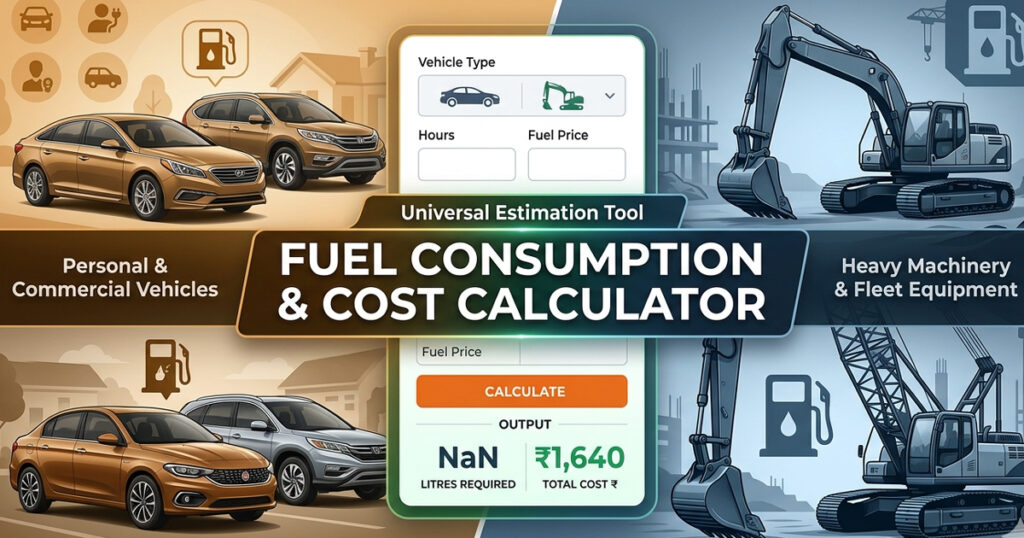
Best Fuel Consumption & Cost Calculator
Estimate fuel burn and trip costs for vehicles, trucks, or heavy machinery.
💡 Pro Tip: High fuel costs? Clogged injectors reduce MPG. Learn how to restore efficiency →
How to reduce fuel cost and improve mileage?
If you want to improve your vehicle mileage, there are many fuel additives to stabilise combustion and minimise the fuel cost. Also, fuel injector cleaner reduces the cost and improves the efficiency.
Estimated Fuel Consumption Reference Chart
Average fuel burn rates (Diesel/Petrol) based on standard operating conditions.
| Vehicle / Machine Class | Avg. Burn (Ltrs/Hr) | Load Intensity |
|---|---|---|
| Economy Sedan / Hatchback | 1.2 – 1.8 | Light |
| SUV / Luxury Sedan | 2.0 – 3.0 | Medium |
| Light Commercial (LCV) | 4.5 – 6.0 | Medium |
| 20-Ton Excavator | 12 – 18 | Standard |
| Piling Rig (Heavy Duty) | 25 – 35 | High Torque |
| 100-Ton Crawler Crane | 10 – 15 | Intermittent |
| Hydra / Pick & Carry Crane | 4 – 7 | Light/Standard |
The Core Engineering Formula for Diesel Consumption
To calculate or audit fuel burn volume per hour for an internal combustion diesel engine, engineers use the Brake Specific Fuel Consumption (BSFC) formula.
Fuel Consumption Rate (L/hr) = [Engine Power (kW) × Load Factor × BSFC (g/kWh)] ÷ Fuel Density (g/L)
Engine Power (kW)
It is designed to gross power output of the engine at the maximum operating RPM.
Load Factor (%)
The average fraction of the maximum power utilized upon a given duty cycle (0.20 to 0.80).
Brake Specific Fuel Consumption (BSFC)
It measures the fuel efficiency, defining fuel mass consumed per unit of energy generated. For modern turbocharged industrial diesel engines, BSFC ranges from 190 g/kWh to 230 g/kWh.
Fuel Density (g/L)
Standard ultra-low sulfur diesel (ULSD) has a density of 835 g/L (0.835 kg/L) at 15°C.
Key Operational Factors That Influence Consumption
1. Machine Load Factor and Duty Cycle
When an excavator digging loose topsoil operates at a lower load than one breaking hard rock with a hydraulic breaker. Also, when mobile cranes burn less fuel while holding a static load compared to the slewing and hoisting cycles.
2. Non-Productive Engine Idling
On average, a heavy-duty machine spends approximately 25% to 40% of its operating life idling. Also, idling consumes only 1.5 to 3.5 liters/hour depending on engine quality, cumulative idle time wastes thousands of liters per year, and powers engine-hour accumulation without generating revenue.
3. Hydraulic and Auxiliary Losses
Variable-displacement hydraulic pumps adjust fluid flow based on load demand. Also, equipment with inefficient or worn hydraulic systems forces the engine to run at higher RPMs to maintain working pressure and decreases fuel economy.
Step-by-Step Guide to Calculation with Example
Let’s assume an example for a 200 kW hydraulic excavator operating on a mid-sized earth-moving site.
- Engine Power: 200 kW
- Average Load Factor: 0.65 (65% duty cycle)
- Engine BSFC: 210 g/kWh
- Diesel Fuel Density: 835 g/L
- Operating Schedule: 10 hours/day, 25 days/month
- Local Fuel Price: $1.25 per Liter
1. Calculate Hourly Fuel Consumption Rate
Hourly Consumption = (200 kW × 0.65 × 210 g/kWh) ÷ 835 g/L = 32.69 Liters/hour
2. Calculate Daily and Monthly Fuel Quantities
Daily Fuel Volume = 32.69 L/hr × 10 hrs/day = 326.95 Liters/day
Monthly Fuel Volume = 326.95 L/day × 25 days/month = 8,173.65 Liters/month
3. Calculate Fuel Expenses
Hourly Fuel Cost = 32.69 L/hr × $1.25/L = $40.87 / hour
Daily Fuel Cost = 326.95 L/day × $1.25/L = $408.68 / day
Monthly Fuel Cost = 8,173.65 L/month × $1.25/L = $10,217.07 / month
Best Practices to Reduce Fleet Fuel Expenses
1. Implement Auto-Idle Shutdown Systems
Configure engine management software that turns off the engines after 3 to 5 minutes of retained idling to save up to 10% in daily fuel usage.
2. Optimize Equipment Eco-Modes
Modern diesel electronic control units (ECUs) provide selectable work modes. Also, running equipment in economy mode caps engine RPMs without losing the hydraulic force during standard digging or lifting.
3. Monitor Tire Inflation and Track Tension
Over-tightened crawler tracks on wheel loaders enhance rolling resistance, forcing the engine to burn additional fuel during transit.
4. Track Operator Telematics
Driving behavior accounts for up to 20% variation in fuel burn between operators on identical machines. It provides smooth joystick control and avoids fast engine lugging.
FAQs
How Much Carbon Dioxide (CO2) Is Emitted per Liter of Diesel Burned?
Burning 1 Liter of industrial diesel fuel develops approximately 2.68 kg of CO2 emissions. Also, a machine burning 8,173 liters per month delivers approximately 21.9 metric tons of direct CO2 emissions.
How do you accurately compute hourly fuel consumption?
The most accurate method is the “Full Tank Method.” Fill the tank to the brim, operate for exactly 5 hours, and then refill. Divide the refill liters by 5. Our calculator above automates this data for precise project planning.
Does a higher RPM always mean higher fuel consumption?
Yes, but Tier-4 engines feature a “Sweet Spot” (Eco Mode). Operating consistently above this range can increase operational costs by 20% or more without improving productivity.