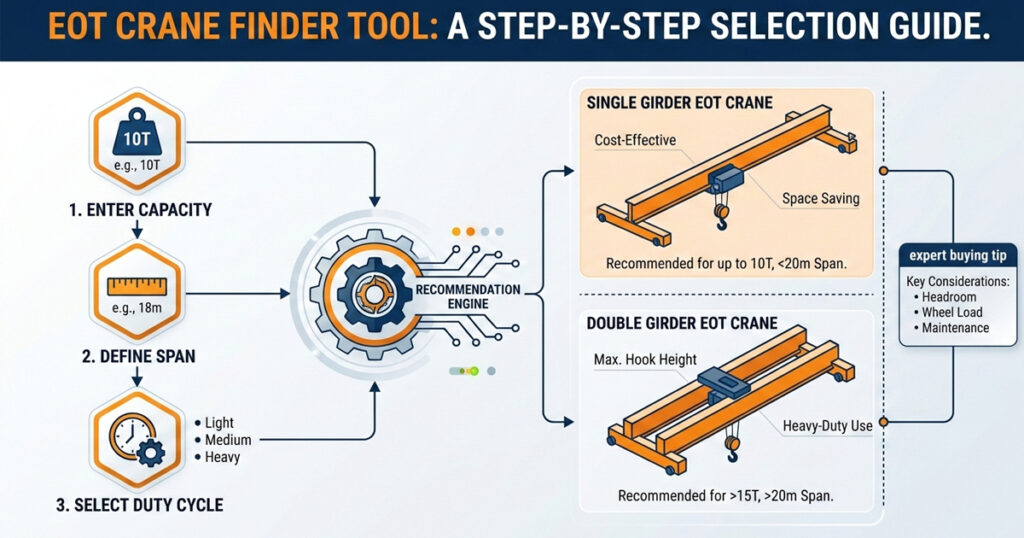
This online tool estimates the overhead crane’s total structural dead weight and the motor power needed for hoisting, cross-travel, and long-travel. Optimize the statistics in advance and consult with your electrical consultant.
Typical Double Girder Reference Values
| SWL (Tons) | Span Range | Typical Structural Weight | Approx. Hoist Motor Power |
|---|---|---|---|
| 10–15 | 18–28 m | 8–14 tons | 11–18.5 kW |
| 20–25 | 22–32 m | 16–26 tons | 18.5–30 kW |
| 30–50 | 25–35 m | 28–48 tons | 30–55 kW |
| 75–100+ | 28–40 m | 55–95+ tons | 55–110 kW |
Double girder EOT cranes are designed to handle heavy-duty material in large-scale industries like steel mills, power plants, and foundries. They are featured with two parallel bridge box girders supporting a top-running hoist trolley that travels along rails mounted on the top of the girders.
Designing and structuring a double girder EOT crane requires balancing structural dead weight with the setup of motor power for cross-bay movement.
Therefore, use our double girder EOT crane power and structural weight calculator to optimize the bridge and trolley structural weights, single drive motor capacities, wheel loads, and total connected power requirements.
What Are the Structural Dead Weight Estimation Principles?
The total dead weight of a double girder EOT crane (Wdead) is distributed into three primary groups:
- Main Bridge Girders (Wbridge): Welded structural box girders designed to withstand vertical bending moments, horizontal slewing force, and torsional loads.
- End Carriages (Wend): Structural steel frames housing the long-travel wheel assemblies, bearings, and drive gearboxes.
- Hoist/Crab/Trolley Frame (Wtrolley): The top-running girder carrying the main hoist motor, rope drums, gearbox, brakes, and cross-travel wheel units.
Double Girder EOT Crane Structural Components
+-----------------------------------------------------------------+
|                         CRAB / TROLLEY                          |
|                     [Hoist Motor & Gearbox]                     |
|                           (W_trolley)                           |
+-----------------------------------------------------------------+
       ||                                                   ||
=======||===================================================||=======  <-- Rail
  +---------------------------------------------------------------+
  |                     MAIN BOX GIRDER 1                         |  Bending Span (S)
  +---------------------------------------------------------------+
  |                     MAIN BOX GIRDER 2                         |
  +---------------------------------------------------------------+
=======||===================================================||=======  <-- Rail
  [End Carriage 1]                                 [End Carriage 2]
What Is the Empirical Structural Weight Calculator (IS 3177/CMAA 70)?
For standard welded box girder designs operating in medium- to heavy-duty applications:
Bridge Weight (Wbridge)
Wbridge ≈ 0.50 × S × (1 + 0.02 × SWL) [Metric Tons]
Trolley / Crab Weight (Wtrolley)
Wtrolley ≈ (0.15 × SWL) + 1.20 [Metric Tons]
Total Crane Dead Weight (Wdead)
Wdead = Wbridge + Wtrolley
Where:
- S: Stands for crane span, centre to centre of gantry rails.
- SWL: Safe working load.
What Is the Motor Power Calculation Mechanism?
EOT cranes use three motion drives and mechanical power based on lifting speed, travel speed, rolling friction resistance, and mechanical transmission efficiency.
1. Main Hoist Motor Power (Phoist)
The hoist motor must lift the combined weight of the calculated capacity and hook block assembly against gravity.
Phoist = (SWL × g × Vh) / (60 × ηh) [kW]
2. Cross Travel (CT) Motor Power (Pct)
The cross-travel motor overcomes rolling friction resistance of the hoist wheel carrying the material load plus the crab weight.
Cross-Travel Rolling Resistance
Rct = froll × (SWL + Wtrolley) × g [kN]
Cross-Travel Motor Power
Pct = (Rct × Vct) / (60 × ηct) [kW]
3. Long Travel (LT) Motor Power (Plt)
The long-travel drive moves the whole crane bridge structure plus the crab and suspended load down the building gantry. On double girder cranes, the drive is split into a twin-drive system.
Long-Travel Rolling Resistance
Rlt = froll × (SWL + Wdead) × g [kN]
Total Long-Travel Motor Power
Plt, total = (Rlt × Vlt) / (60 × ηlt) [kW]
Per LT Motor Rating
Plt, motor = Plt, total / 2 [kW]
Frequently Asked Questions (FAQs)
Why Choose a Double Girder EOT Crane Over a Single Girder Crane?
A double girder crane delivers higher hook lift height, greater span capabilities (30 meters), higher lifting capacities (15 MT to 500+ MT), and facilities maintenance walkways and operator cabs.
How Does Variable Frequency Drive (VFD) Integration Affect Motor Selection?
Setting up VFDs on CT and LT drives eliminates high direct-on-line (DOL) starting current surges and delivers smooth acceleration/deceleration ramps to avoid load sway and reduce mechanical braking wear. Also, inverter-duty motors with forced cooling fans should be specified for slow-speed creep operations.
Related EOT Crane Resources
Explore our industrial engineering calculators and technical resources for more information about crane selection, load calculations, and material-handling equipment.
Double Girder EOT Crane Wheel Load & Hoist Power Calculator
Advanced Structural Weight Estimation for Heavy-Duty Lifting Systems
🏗️ Double Girder Technical Report
| Est. Total Crane Weight: | Tons |
| Max Wheel Load (Static): | kN |
| Estimated Hoist Power: | kW |
*Calculations assume standard box girder construction and 85% mechanical efficiency. Final design must be certified by a structural engineer.
Use the above tool and calculate the double girder eot cranes specifications.
This amazing toll is designed to handle Engineering Standards Used at IS-3177 and CMAA Spec 70