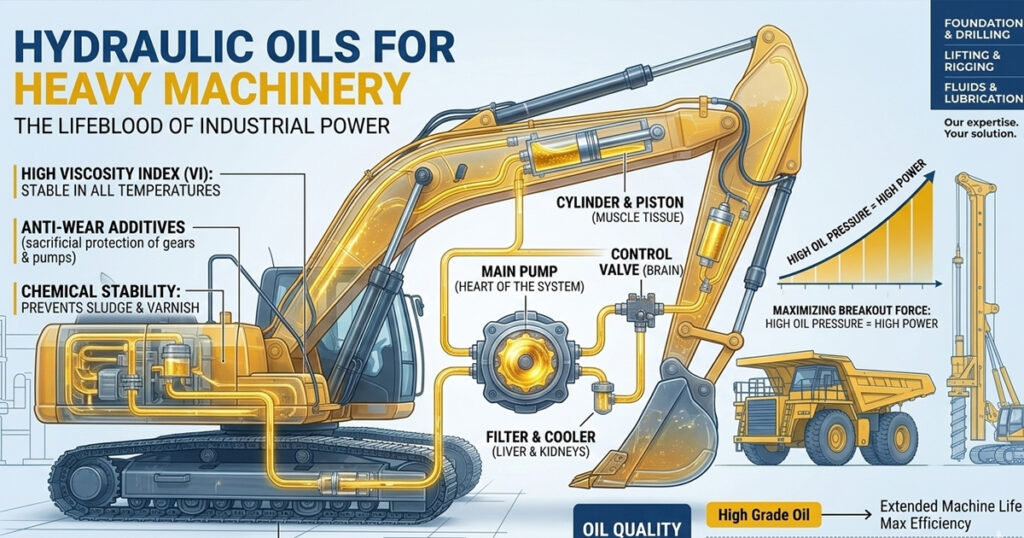

Base oil is powerful enough to protect high-performance machinery. Oil additives are chemical compounds mixed into the base oil to improve its protective properties and suppress undesirable traits. To extend the service life of both the lubricant and the machine.
Why are Oil Additives Necessary?
In a hydraulic system or a gearbox, the oil faces three primary enemies: Heat, Pressure, and Contamination. Additives act as the soldiers on the front line.
Film Strength: Protect the metal-to-metal contact when loads are extreme.
Chemical Stability: Avoid the oil from turning into sludge due to oxidation.
Contamination Control: Keeping dirt and water from attacking metal surfaces.
The Must-Have Additives Table
| Additive Class | Chemical Function | Engineering Benefit |
|---|---|---|
| Anti-Wear (AW) | Forms a protective chemical film (usually Zinc-based). | Prevents scuffing and scoring in hydraulic pumps and valves. |
| Extreme Pressure (EP) | Reacts with metal surfaces under high heat to prevent welding. | Crucial for high-torque gearboxes in cranes and rotary rigs. |
| Oxidation Inhibitors | Neutralizes oxygen radicals to prevent oil breakdown. | Extends oil life and prevents “Varnish” or sludge formation. |
| Corrosion Inhibitors | Creates a water-repellent barrier on metal components. | Protects internal parts from rust during machine downtime. |
| Viscosity Index Improvers | Polymeric molecules that expand when heated. | Ensures oil doesn’t thin out in desert heat or thicken in cold. |
🧪 Additive Life & TAN Monitor
Estimate additive health based on chemical oxidation markers.
How it is used (The Sacrificial Layer)
The most important concept for an engineer to understand is the Sacrificial Mechanism. Also, it depends upon the workflow in the industries along with the conditions eot crane oil, pilling rig, etc.
- As the hydraulic pump spins, pressure become more high that liquid oil is squeezed out from between the metal parts.
- At this point, anti-wear (AW) molecules stick to the metal.
- When both metal surfaces rub, they rub against the additive layer instead of each other.
Summary Table: Oil Additives Application by Machine
| Machine Type | Key Additive | Engineering Purpose |
|---|---|---|
| Excavator / Piling Rig | Viscosity Index (VI) Improver | Prevents oil thinning under direct sunlight and high-load hydraulic cycles. |
| EOT Crane Hoist | Tackiness Agents | Ensures lubricant "clings" to wire ropes/gears; prevents floor contamination. |
| Hydraulic Grab | Seal Swell Agents | Conditions rubber O-rings to prevent "weeping" leaks into sensitive cargo. |
| Waste Shredder | Anti-Foaming Agents | Dissipates air bubbles caused by high vibration; prevents hydraulic power loss. |
Frequently Asked Question
Q: Can I add aftermarket additives to my hydraulic tank?
Ans: Use caution. Most modern oils have a carefully balanced additive package. Adding a random bottle of stop-leak or friction reducer causes a chemical reaction that causes the original additives to drop out of the oil, turning into grit.
Q: What is Zinc-Free (Ashless) Oil?
Ans: It depends upon the environmental conditions, or high-precision pumps require ashless oil.
Q: Does the colour of the oil tell me if the additives are working?
Ans: Not necessarily. Some additives change colour as they react with heat, which is normal, and oil analysis (ASTM D4378) represents the oil conditions after the additives.