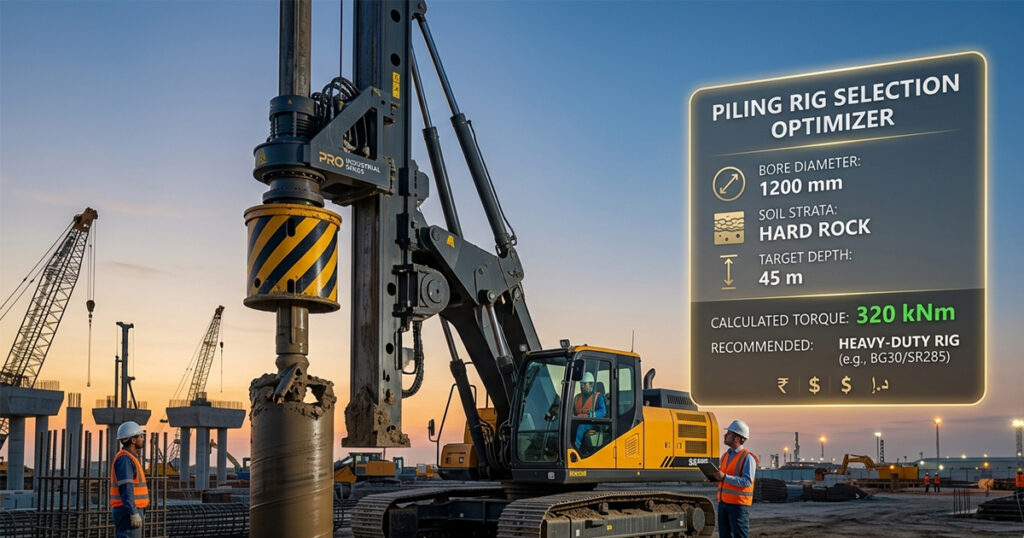
The Piling Rig is the most vital machinery in the drilling & foundation sectors. Unlike standard (borewell and hill drilling rigs), which focus on accurate diameter access for water or rock-blasting, a piling rig is designed for load-bearing. It drills deep columns into the earth to construct high-rise buildings, bridges, and big industrial plants.
Key Piling Rigs Methodologies
Most engineers recognised the exact match of Rig’s torque and crowd force to the soil conditions. Need to calculate the production rate for any foundation project? Use our piling rig calculator to get estimates accordingly.
Rotary Bored Piling: Designed to handle high-load building structures in hard rock or clay. It uses an excavator-style hydraulic component for high torque.
Continuous Flight Auger (CFA): A unique machine designed for rapid drilling in urban areas with zero vibration.
Driven Pilling: Designed with high-quality hydraulic hammers and a strong and stable chassis to manage the heavy counterweights.
Technical Specifications: Rotary vs. Driven
| Feature | Rotary Piling Rig (Bored) | Impact / Driven Rig |
|---|---|---|
| Primary Base | Heavy Crawler Mounted (for stability) | Crawler or Truck Mounted |
| Max Depth | Up to 100 meters (Telescopic) | 20 – 40 meters (Sectional) |
| Core Component | Kelly Bar & Rotary Drive Head | Hydraulic Hammer & Leader Mast |
| Hydraulic Flow | High-Pressure Constant Auxiliary | High-Flow Pulsation (for Hammer Strike) |
| Geology Suitability | Hard Rock, Clay, Silt (with Casing) | Soft Soil, Sand, Marine Environments |
🏗️ Quick Depth Check (Kelly Bar)
Estimate maximum drilling depth for international rig configurations.
Piling Rig Technical Comparison: Rotary vs. CFA
| Method | Max Torque (Avg) | Best Soil Condition |
|---|---|---|
| Rotary (Kelly Bar) | 150 – 450 kNm | Rock, Hard Clay, Boulders |
| CFA (Auger) | 80 – 200 kNm | Soft Sand, Wet Soil, Silt |
| Low Headroom | 40 – 100 kNm | Restricted Spaces/Inside Buildings |
The Vital Role of Maintenance & Fluids
Piling rigs are heavy-duty machinery designed to operate in high-friction environmental conditions; their mechanical health requires timely oil and lubrication for high performance.
A. Hydraulic System Integrity
Machines rely heavily on hydraulic pressure to generate “crowd force”. Without expert repair and specialized industrial oils & greases, hydraulic pump failures, exhaust issues, and seal failures lead to expensive downtime.
B. Rotary Head & Gearbox Protection
The rotary head is the heart of the rig, and like an eot crane hoist gearbox, it handles huge torque. Using an ISO VG320 gear oil enables the gears not shear under the stress of rock drilling.
C. Hinge Pin & Mast Lubrication
The heavy mast and sliding Kelly bar need a tacky grease to perform in wet soil. Using high-quality lithium EP2 Grease avoids the mast from “chattering” and ensures the proper and smooth vertical movement.
Global Safety & Efficiency Standards
Using a piling rig for deep foundation offers many pros above the shallow methods:
Seismic Resistance: Necessary for tall structures in earthquake zones.
High Load Capacity: Designed for huge bridge structures.
Precision: Modern rigs use a digital sensor to confirm piles are perfectly aligned vertically.
Piling Operations & Maintenance FAQ
Q: Can a standard excavator be used for piling?
Ans: Yes. By equipping a standard excavator with specialized attachments like a vibratory hammer or a hydraulic grab, it can effectively perform light piling for foundations. This is a cost-effective solution for sheet piling or small-diameter boreholes where a dedicated rig isn’t required.
Q: Why is oil analysis important for piling rigs?
Ans: Piling rigs frequently operate in harsh, dusty, or muddy environments that put extreme stress on the engine and hydraulics. Regular oil analysis is essential to detect microscopic metal shavings or contaminants early. This allows you to address internal wear before it leads to a catastrophic and expensive total engine or pump failure.