In the world of bulk material handling, the mechanical grab bucket is the most durable grab operate without electricity, and a cost-effective attachment for high-volume lifting. It is operated by a crane’s wire rope system and enhances productivity in ports, steel mills, and other facilities.
What is a Mechanical Grab Bucket?
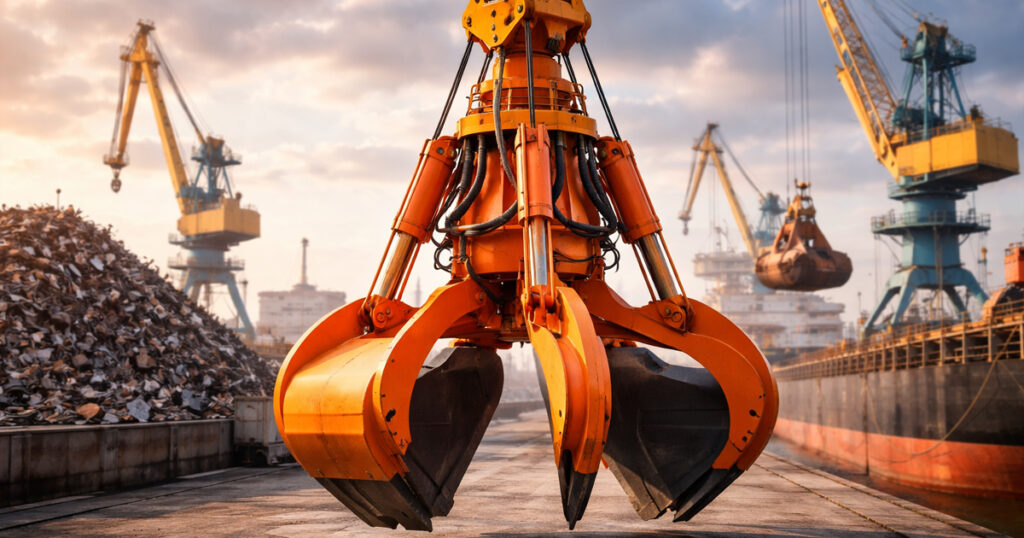
A mechanical grab is a heavy-duty “clamping” attachment designed to transport loose material. It consists of a master head, a synchronised hinge mechanism, and two or more cells (JAWS).
The Rope Logic: It functions by the crane’s holding and closing lines.
Durability: It is designed without hydraulic cylinders, seals, or hoses, and operates in extreme temperatures and abrasive environments (coal, sand, iron ore).
Comprehensive List of Grab Types
Selecting the right jaw design is important for efficient “fill factors” and preventing material loss.
| Grab Type | Design Style | Best Suited Materials | Engineering Key Feature |
|---|---|---|---|
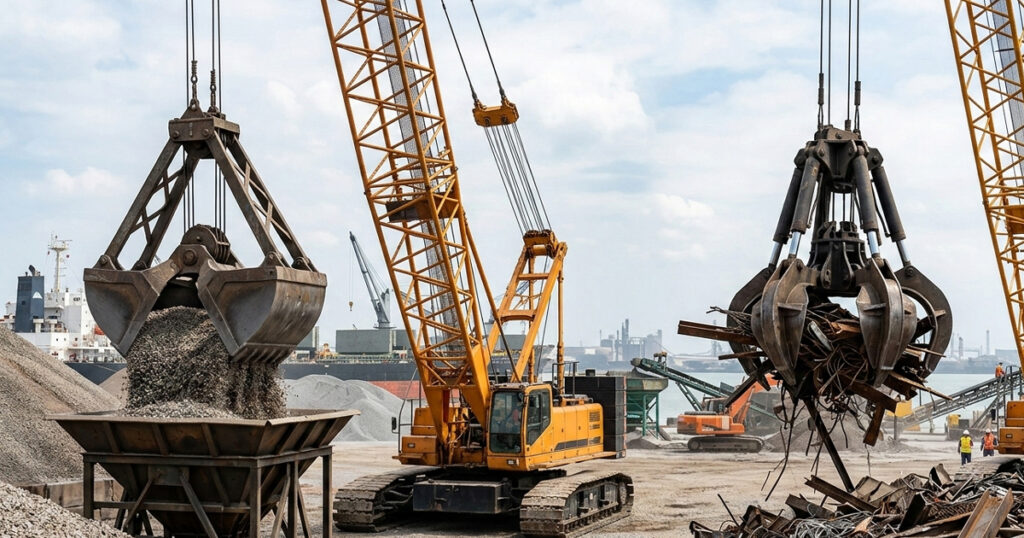
| Clamshell Grab | Two symmetrical shells (jaws). | Sand, Coal, Grains, Cement, Fertilizer. | Zero Leakage: High-precision sealing for fine particles. |
| Orange Peel Grab | 3 to 8 independent curved tines. | Scrap Metal, Rocks, Waste, Irregular Debris. | High Penetration: Deep digging into interlocking materials. |
| Dredging Grab | Heavily reinforced, perforated shells. | Mud, Clay, Silt (Underwater). | Water Drainage: Perforated design retains solids while water escapes. |
| Cactus Grab | 3-4 heavy-duty pointed jaws. | Coarse and fine mix (Iron Ore). | Crushing Power: Capable of breaking large chunks during the scoop. |
⚙️ Quick Efficiency Check
Balance your bucket’s dead weight against its payload for maximum throughput.
Technical Specification Table (Engineering Data)
The table enables engineers to find the exact match of grab's weight and volume to the crane's Dafe Working Load (SWL).
| Specification | Light Duty | Medium Duty | Heavy Duty | Extra Heavy Duty |
|---|---|---|---|---|
| Material Density | < 1.2 t/m³ | 1.2 – 2.0 t/m³ | 2.0 – 2.6 t/m³ | > 2.6 t/m³ |
| Typical Cargo | Coal, Grain, Slag | Sand, Gravel, Cement | Iron Ore, Scrap Steel | Heavy Minerals, Copper Ore |
| Dead Weight Ratio | ~ 40% | ~ 50% | ~ 60% | Up to 70% |
| Shell Material | Mild Steel (Q235B) | High Tensile Steel | Hardox 450 Plates | Hardox 500 + Cast Teeth |
| Closing Mechanism | 2-Rope / Touchdown | 2 or 4-Rope | 4-Rope | 4-Rope High Friction |
| Volume Range | 10 – 30 m³ | 5 – 15 m³ | 1 – 8 m³ | 0.5 – 4 m³ |
How It Operates (The Mechanical Cycle)
Mechanical grabs operate by a gravity-and-tension duty cycle, and the grab bucket maximises the workflow when attached on eot cranes, ship cranes, etc.
Lowering (Open): The grab is lowered while the closing line and weight of the shells help them to hinge open.
Digging (Closing): Once the grab rests on the material, the crane pulls the closing line and passes by internal pulleys, creating a mechanical advantage that pulls the jaws closed.
Hosting (Lifting): Both the holding and closing lines are pulled at equal speed to lift the grabs with material without opening it.
Discharge (Opening): Over the hook, the operator stops the closing line. Gravity pulls the shells apart, releasing the load, etc.
Maintenance & Safety Protocols
Sheave lubrication: The pulleys inside the head and sheaves must be greased with Lithium EP2 Grease daily.
Lip Alignment: Check the "lips"(edge) of the sheels weekly. If they do not seal perfectly, lose significant material during transit.
Wire Rope Inspection: Mechanical grabs are "rope killers" due to tight bending, and replace ropes immediately if more than 10% of the wire in a strand is broken.
Technical FAQ (The "Expert" Lens)
Q: How do you choose between a 2-rope and 4-rope grab?
Ans: It depends on your cranes; a 2-ropecrane has one drum for lifting and one for closing. while in 4-rope grabs ttwo for lifting, and two for holding.
Q: What is the most common failure point?
Ans: Wire rope wear at sheaves, because the rope bends tightly inside the grabs. Timely oils& lubrications are required for the continuous operation.