For high-volume industrial material like ports, steel plants, and scrap yards, the grab buckets are the most demanding attachment. It enhances the production cycle, while choosing the wrong grab creates the mechanical stress that leads to crane failure.
At proindustrialspec, define the grabs by their drive system and material geometry.
The Master Comparison: Grab Bucket Driving Mechanisms
The table of grab types defines the power and uses of grabs.
| Grab Mechanism | Power Source | Key Advantage | Primary Application |
|---|---|---|---|
| Mechanical (Rope) | Crane Winch / Wire Ropes | Simple design; no electrical/hydraulic cables needed. | Bulk carriers, ports, and dredging. |
| Electro-Hydraulic | Electric Motor (Internal Pump) | Highest closing force and precision control. | Steel plants, WTE plants, and EOT cranes. |
| Remote Control (RRC) | Internal Battery / Diesel | Plug-and-play; works with any single-hook crane. | Ship-to-shore unloading and rental fleets. |
| Excavator Hydraulic | Machine Aux. Hydraulics | Fast cycle times and 360° rotation capability. | Demolition, scrap yards, and recycling. |
📦 Quick Volume Estimator
Core Design Philosophies
A. Clamshell Grabs ( the “Scooper”)
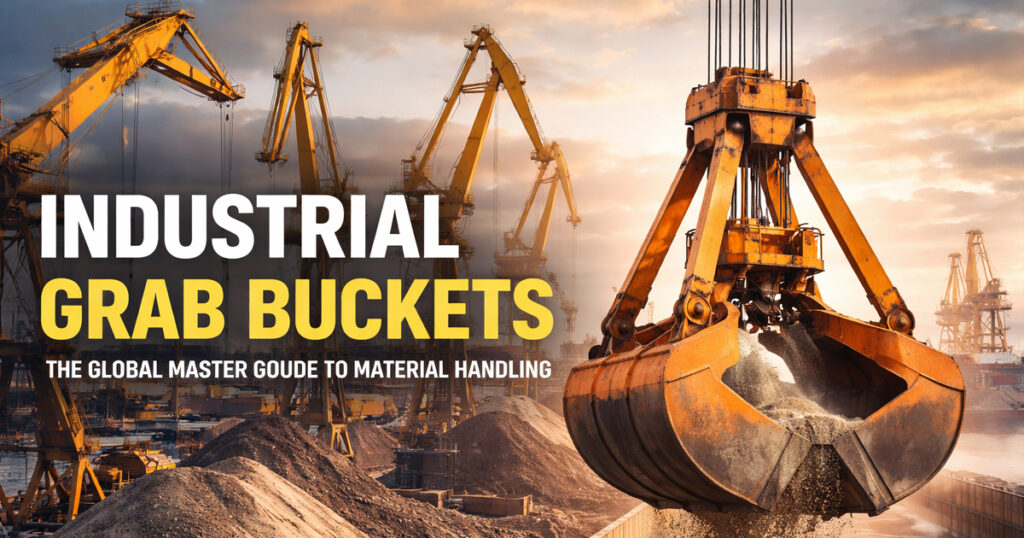
These types of grabs are designed with two shells and powered by a hydraulic system, mechanical, and handle the material like granular & flowable, coal, sand, grain, and fertiliser, and are ideal for handling the fine powders.
B. Orange Peel / Cactus Grabs (The “Gripper”)
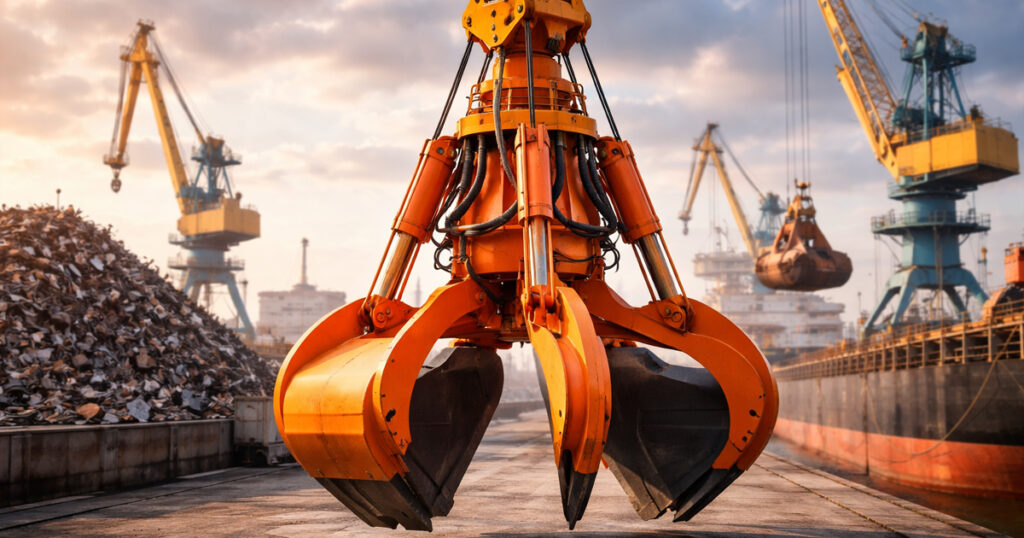
It is featured with 4 to 8 independent tines(jaws), and is designed for irregular & tangled material like scrap material, rocks, and municipal waste. It allows the grab to wrap around uneven shapes for a secure grip.
C. Log & Timber Grabs
It is a specialised curved arms handling of single or bundle logs with spec high-pressue holding jaw prevent the accidental loading.
Why Choice Matters: Advantage vs. Consequence
The Advantage of the “Right Match”:
Increased Tonnage: A perfect grab with the right capacity and load as per material density ensures the crane’s maximum Safe Working Load (SWL) without overloading.
Reduced “Dead Weight”: Modern design of grabs using HARDOX 450/500 allows for lighter grabs that lift more payload.
Lower Maintenance: Tested grab to material prevents “lip Deformation” and hinge-pin shearing.
The Cost of the “Wrong Match”:
Grabs are often designed with low-quality materials, lead to leakage and exhaust the hydraulic cylinder, and damage the rope also.
- The “Double-handling” Trap
- Hydraulic Overheating
- Rope Fatique
Global Maintenance: The “Pro” Checklist
Grab buckets need regular repair, maintenance and change grab oil on time for the industry’s progress.
| Component | Maintenance Action | Lubricant / Part Spec | Frequency |
|---|---|---|---|
| Hinge Pins & Bushings | High-pressure Greasing | Lithium EP2 / MoS2 Grease | Daily (Per Shift) |
| Cutting Edges (Lips) | Visual Wear Check | Hardox 450/500 Welding Rods | Weekly |
| Hydraulic Reservoir | Oil Level & Quality Audit | ISO VG 46 / 68 Anti-Wear | Monthly |
| Wire Rope Guides | Abrasion & Tension Check | Replace if strands > 10% broken | Weekly |
| Electrical Seals | Ingress Protection Audit | IP66/67 Rated Gaskets | Quarterly |
Technical FAQ
Q: What is the difference between a 2-Rope and 4-Rope Mechanical Grab?
Ans: Both types of grabs mechanism is similar, but the two-rope operate when one rope is used for lifting and the other for opening/closing the grabs. Four-rope grabs use two ropes for each grab and provide more stability.
Q: Can a Wireless Remote Control (RRC) grab work on any crane?
Ans: Yes, because it is a self-contained grab bucket and hung from a standard crane. It does not need electrical cables or hydraulic hoses from the crane.
Q: Why do steel plants prefer Electro-Hydraulic grabs?
Ans: Grab provide highest closing force powered by EOT cranes and electricity. Modern electric grabs are designed for underwater operation, with a high-quality structure and epoxy.