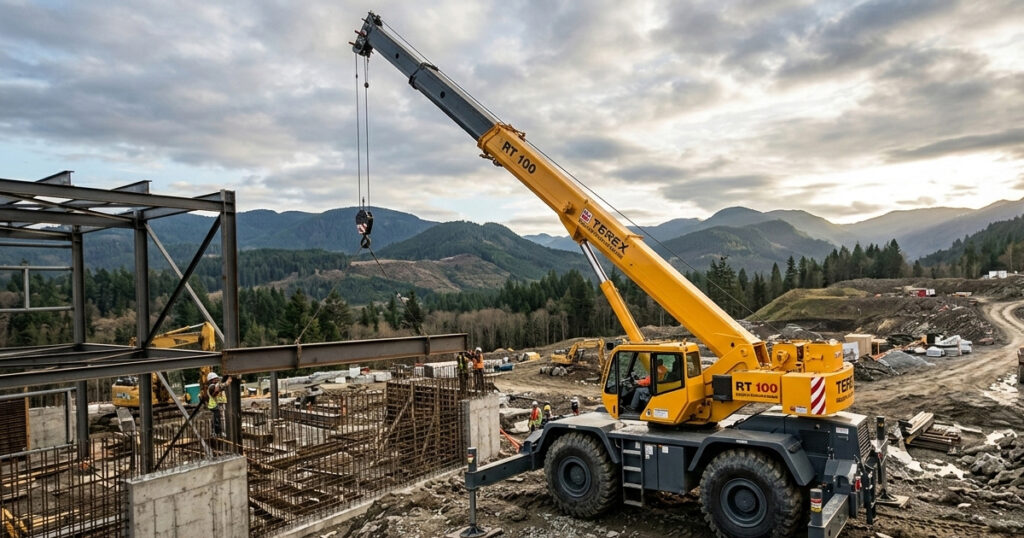
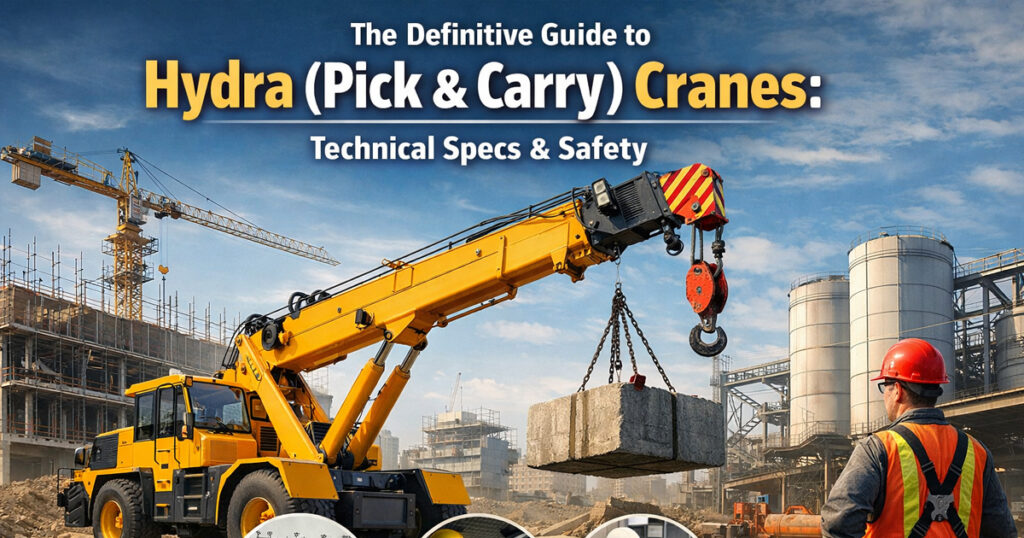
The hydra cranes, technically known as a Pick & Carry Crane, Yard Cranes or Industrial Carry Decks, is a mobile lifting machine. Hydra crane is designed to lift and move the load from one place to another. It is a type of giant crane, and its versatility makes it a workhorse of ports, construction sites, and marble yards. Its articulated steering and shifting centre of gravity require technical knowledge to operate safely.
Structural Classification: The “Hydra” Anatomy
Hydra cranes are designed primarily by their lifting capacity from 9 tons to 25 tons.
Chassis: Designed (centre-pivot) steering enables a tight turning radius in narrow industrial layouts.
Boom: Amazing boom reach with a 2-part or 3-part telescopic boom powered by heavy-duty hydraulic cylinders.
Engine: commonly powered by 4-cylinder water-cooled diesel engines range from 50 HP to 100 HP.
The Critical “Load Chart” Logic
The most vital specifications of a hydra crane are not its maximum capacity, but its radius capacity.
Pro Tip: The boom of cranes is fully retracted and at its highest angle when a 14-ton hydra can only lift 14 ton weight. Here leverage principle applies when the boom extends horizontally, and the capacity drops.
| Boom Length (m) | Boom Angle (°) | Safe Working Load (SWL) |
|---|---|---|
| 3.0 m (Fully Retracted) | 60° | 14,000 kg |
| 6.0 m (Intermediate Extension) | 30° | 4,500 kg |
| 10.0 m (Full Extension) | 10° | 1,200 kg |
⚠️ Quick Stability Check
Estimate capacity reduction during articulated turns.
Global Technical Specifications (Standard 15T – 25T Class)
This table reflects the engineering standards required for international compliance (ISO 4301-1 / ASME B30.5).
| Attribute | International / Metric Standard | US / Imperial Equivalent |
|---|---|---|
| Lifting Capacity | 12,000 – 25,000 kg | 26,000 – 55,000 lbs |
| Engine Power | 37 – 75 kW | 50 – 100 HP |
| Emissions Standard | Euro V / Stage V | EPA Tier 4 Final |
| Transmission | Synchromesh / Power Shuttle | Torque Converter Optional |
| Max Travel Speed | 25 – 40 km/h | 15 – 25 mph |
| Hydraulic Pressure | 210 – 250 bar | 3,000 – 3,600 psi |
| Gradeability | 20% – 30% Slope | 11° – 17° Incline |
| Steering Angle | +/- 40° to 55° | Articulated Centre Pivot |
| Braking System | Air-over-Hydraulic | Fail-safe Dual Circuit |
Maintenance & Fluid Specs (The “Pro” Lubrication Guide)
Hydra mobile cranes have higher fluid contamination risks than indoor EOT cranes.
A. Hydraulic System (The Lifeblood)
Specification: ISO VG 46 or 68 Hydraulic Oil (Anti-Wear).
Pro Specification: Use VG 68 in high-temperature environments to maintain viscosity.
B. Engine & Gearbox
Engine Oil: 15W-40 (API CH-4/CI-4).
Transmission: EP 90 or 80W-90 Gear Oil.
Grease: Lithium EP2 Grease
| Fluid Type | Global Specification | Cold Climate (Europe / Canada) |
Hot Climate (India / Middle East) |
|---|---|---|---|
| Hydraulic Oil | ISO 11158 (HM/HV) | ISO VG 32 | ISO VG 68 / 100 |
| Engine Oil | API CK-4 / ACEA E9 | 0W-40 Synthetic | 15W-40 Multigrade |
| Axle / Gear Oil | API GL-5 | 75W-90 | 85W-140 |
| Boom Grease | Moly-Disulfide (MoS2) | Low-Temp Synthetic | High-Drop Point Mineral |
Global Safety & Design Standards
To prevent the common “Troppling” accidents integrated with Hydra cranes, the following data are important:
- Safe Load Indicator(SLI): A built-in digital display that warns the operator to keep an eye on the sale-limit load for the particular angle.
- Over-Hoist Cut-off: Protect the hook from hitting the boom head.
- Pressure Relief Valves: Prevent the hydraulic system from bursting under extreme loads.
- Articulated Lock: It stabilises the centre-pivot during high-speed road travel.
- The American “Carry Deck” Perspective (ASME B30.5): Global specs demand a 75% tipping ratio.
- The European Efficiency (EN 13000): A pick & Carry crane cannot function without an active LMI.
Technical FAQ
Q: Why is a Hydra crane considered more dangerous than a Crawler crane?
Ans: Because it lacks outriggers. Centre of gravity shifts outside the stability triangle if the ground is uneven ot the operator turn too sharply while carrying a load. It causes the crane to flip.
Q: What is “Free Fall” in Hydra cranes?
Ans: It was featured in the old crane model for fast dropping of the hook. In modern safety standards, have replaced with controlled power-lowering the hook to avoid any kind of casualty.
Q: How often should I change the hydraulic oil filter?
Ans: It is recommended to change every 500 working hours. A clogged filter causes cavitation in the pump to the permanent loss of lifting power.
Q: Can I drive a Hydra crane on the highway?
Ans: Yes