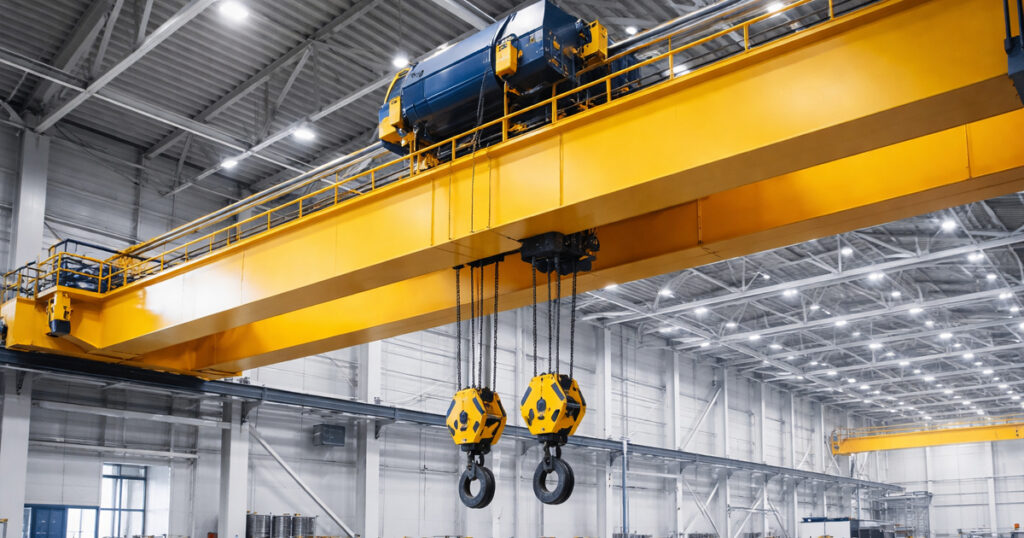
The Electric Overhead Travelling (EOT) Cranes, also known as an overhead crane, are the most common material-moving solution for modern industrial facilities. By setting up the girder runway system, these travelling cranes provide an unobstructed path for moving loads and unloading across the horizontal and vertical three-axes is: Long Travel (LT), Cross Travel (CT), and Hoisting. Also, maximise the floor space and operational efficiency.
At ProIndustrialSpecs, we provide the data-driven technical insights needed to specify, operate, and maintain cranes and find eot crane for lifting at an industrial standard.
Structural Classifications
Design of the crane depends upon the span and load capacity as follows:
Single Girder EOT Crane
Design: It is single bridge beam crane with an underslung hoist.
Capacity Range: Range from 1 ton to 20 tons.
Applications: Light-to-medium designs, maintenance workshops, low-headroom industries.
Key Advantage: lower dead weight and reduced wheel load on the building columns.
Double Girder EOT Crane
Design: Two parallel bridge girders with a top-running trolley (crab).
Capacity Range: 20 Tons to 500+ tons.
Application: Steel Mills, Cement Plants, Foundries, and Power Plant etc.
Key Advantage: Maximum hook height and ability to integrate maintenance walkways and platforms.
Technical Performance Metrics (The Spec Sheet)
| Attribute | Industry Standard Range | Engineering Specification Detail |
|---|---|---|
| Duty Cycle | M3 to M8 (IS 3177 / FEM) | Defines structural fatigue life and motor thermal durability. |
| Lifting Speed | 3 to 10 m/min | Typically optimized via VVVF/VFD for micro-speed precision. |
| Cross Travel Speed | 10 to 30 m/min | Lateral movement of the crab/hoist across the bridge girders. |
| Long Travel Speed | 20 to 40 m/min | Longitudinal movement of the entire crane along the gantry rails. |
| Main Hoist Motor | Squirrel Cage / Slip Ring | IE3 High Efficiency class is now the global industrial standard. |
| Brake Type | Electro-Hydraulic Thruster | Fail-safe load holding mechanism for emergency stops. |
🏗️ Quick Span Check
Estimate the allowable deflection for your crane span (L/750 standard).
Strategic Applications & Industrial Intent
Steel Sector: Cranes with heavy-duty M7/M8 specifications for handling molten metal and ladles.
Automotive Industry: High-speed M5 cranes operate in synchronised assembly lines.
Power generation: Precision M3/M4 cranes for turbine hall maintenance(requires “Micro-speed’).
Chemical/Oil & Gas: Explosion-proof(Flameproof) cranes with spar-resistant components.
| Industry Sector | Primary Usage | Critical Engineering Requirement |
|---|---|---|
| Steel & Foundries | Moving molten metal, ladles, and billets. | High Heat Shielding, Insulated Cabins & M8 Duty Cycle. |
| Power Plants | Turbine rotor placement and maintenance. | Precision “Micro-speed” Control (often < 0.5 m/min). |
| Automotive | High-speed assembly line movement. | High Frequency/Speed with VFD synchronization. |
| Oil & Gas | Movement of volatile/pressurized components. | Explosion-proof (Flameproof) Electricals & Non-sparking tools. |
| Warehousing | Bulk loading and unloading of containers. | High Span Structural Stability & Long Travel durability. |
Specialised Attachments (Below-the-Hook)
EOT cranes act as a platform for various types of material handling processes and suppoting attachements includes:
- Mechanical Clamshell Grabs
- Hydraulic Orange Peel Grabs
- Industrial Electromagnets
- C-Hooks & Spreader Beams
Maintenance & Lubrication Protocol
Like industrial machines, EOT Cranes oils need to be checked and changed on time to prevent structural fatigue and mechanical failure. Hence, a few “pro” lubrication is given below:
A. Lubrication Points & Oil Specifications
| Critical Component | Lubrication Type | Technical Specification | Service Frequency |
|---|---|---|---|
| Main Hoist Gearbox | Extreme Pressure (EP) Oil | ISO VG 220 / 320 | Check Monthly / Change Yearly |
| CT/LT Gearboxes | Industrial Gear Oil | ISO VG 150 / 220 | Every 2000 Working Hours |
| Wire Rope | Penetrating Rope Dressing | Graphite or MoS2 Base | Every 3 Months |
| Open Gears/Pinions | Heavy-Duty Tack Grease | NLGI 2 / Lithium EP2 | Weekly (High Friction) |
| Wheel Bearings | High-Temperature Grease | Lithium Complex Grease | Every 6 Months |
B. The “Wire Rope” Deep Dive
The wire rope hose is the most important component; it is advised to use general-purpose grease. It falls on the surface and traps dirt. Also, consider a pressure-lubricator or a brush with penetrating oil that reaches the inner core of the rope to protect against internal corrosion.
Safety & Operational Compliance
Cranes designed with multiple features and specifications as per the demand of industries are as follows.
Anti-Sway System: Integrated Variable Frequency Drives (VFD) logic to minimise the pendulum effect of the load.
Storm Brakes: Feature implementation in outdoor cranes to prevent wind-drifting.
Visual & Audible Alarms: Flashers, overload protection sensor, and sirens that activate during crane movement.
Frequently Asked Questions
Q: What does “Duty Cycle” mean for an EOT Crane?
Ans: It is vital to understand the duty cycle because M3 cranes refer to occasional maintenance, while M8 crane is for 24/7 continuous operation in steel mills.
Q: What is the difference between a Gantry crane and an EOT crane?
Ans: An EOT crane runs on parallel elevated rails fixed on a building. A gantry crane has legs and runs on ground-level rails, usually for outdoor use.
Q: Can I use automotive gear oil (like 90W) in my EOT crane?
Ans: No.
Q: Why is my crane making a grinding noise on the rails?
Ans: It occurs due to Fly Flanges or Crane Skewing. Check if the crane wheel flange lubrication system is working.