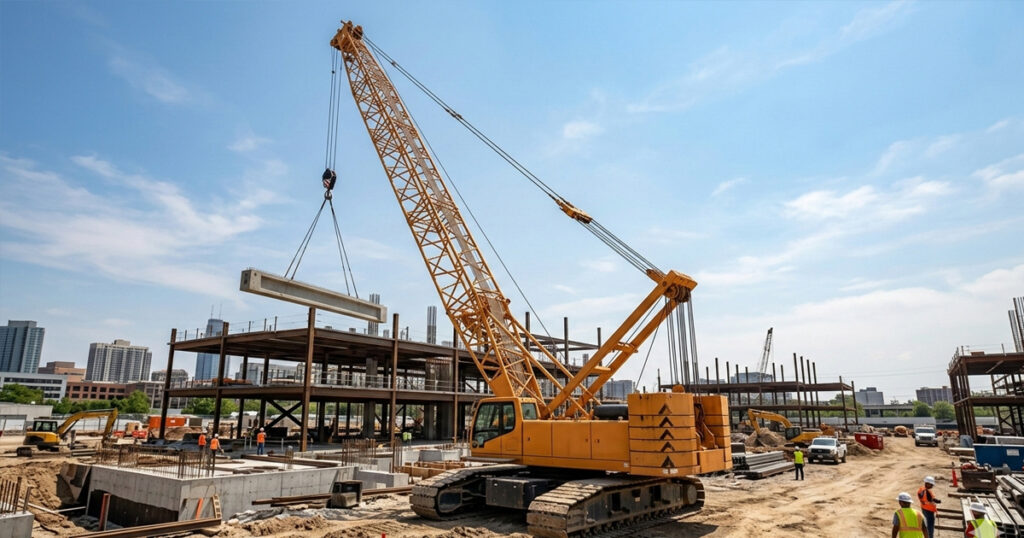
Crawler cranes, often regarded as the heavy-duty counterparts to mobile cranes, provide superior performance when cranes move the bulk loads over difficult terrain. Mounted on an undercarriage with a heavy-duty rig machine balances the weight over a wide area.
What is a Crawler Crane?
It is a type of mobile crane mounted on an undercarriage with tracks. These tracks deliver both mobility and stability when required to navigate soft soil or uneven ground, where other standard cranes can not operate the lifting task.
Core Components
Get more informationon the functions and anatomy of it:
Crawler Tracks: It is designed to distribute weight over a large zone and reduce the ground pressure.
Carbody: The central frame connected to the tracks to revolve the superstructure.
Superstructure: It contains the engine, counterweight, and operator’s cabin.
Lattice Boom: It is used for lifting and is designed with high-quality steel.
How to Operate/Drive a Crawler Crane: Operational Workflow
Operating a crawler crane is not about pulling levers; it is a calculation of engineering. Because machines can weigh hundreds of tons, their operator follow a strict protocol
Lattice boom operate thorugh a complex system of wire ropes and pulleys, while durability and stability are maintained by the load moment indicator (LMI).
- Site Assessment and Ground Pressure
It is required to optimise the ground before arrival, and the operator calculates the ground bearing capacity (GBC). Thus, tracks distribute weight properly and lift massive loads on uneven ground. - Assembly and “Walking”
It is easy to assemble on-site using a smaller assist crane. Once assembled, it has a unique “pick-and-carry” capability to pick and move the load in bulk quantities. - Lifting Operations: Old cranes use the pulleys and wire ropes to manage the load, while modern cranes use the onboard computer Load Moment Indicators (LMI) to ensure the crane’s stability.
Key Advantages of Crawler Cranes
Why choose tracks over tyres? The benefits are connected to the physics and versatility.
Superior Stability: It operates with a 360-degree lifting radius with consistent capacity and a wide footprint.
All-Terrain-Mobility: They excel on soft earth, or surface includes sand, mud, and designing them go-to for early-stage foundation.
Massive Lifting Capacity: Yes, it is designed to lift and move the massive loads, mega-lifts.
Pick-and-Carry: The ability to carry while under load significantly enhances the efficiency on a sprawling job.
Technical Specifications: At a Glance
This table represents the typical parameters for mid-range to heavy-duty crawler cranes.
| Feature | Lattice Boom Crawler | Telescopic Crawler |
|---|---|---|
| Max Capacity | 50 Tons – 3,000+ Tons | 30 Tons – 250 Tons |
| Setup Time | Days (Requires on-site assembly) | Minutes (Hydraulic Extension) |
| Best Use Case | Long-term megaprojects | Quick, heavy lifts on soft terrain |
| Ground Pressure | Very Low (Excellent distribution) | Moderate |
| Reach | Exceptional (Modular sections) | Limited (Fixed stages) |
⚖️ Quick Load Check
Estimate if your lift is within the 75% stability margin.
Pro-Maintenance & Fluid Standards
To keep the drive and winches running smoothly, use high-performance hydraulic oils to avoid cavitation in crawler motors. Also, add oil additives to the gearbox to deliver extreme pressure.
Note for Project Managers:
Note for Project Managers: When calculating costs, remember that while crawler cranes offer the best lifting capacity, the mobilisation and demobilisation costs (shipping and assembly) are higher than those of mobile truck cranes.
Frequently Asked Questions (FAQs)
Q: Can a crawler crane move on a public road?
Ans: No, because it uses tracks often wider than a road. Crawler cranes' unique functions are disassembled and transported anywhere.
Q: What is the difference between a lattice boom and a telescopic boom?
Ans: Lattice boom is designed with a fixed steel grid for vertical lift, while the telescopic boom uses hydraulic technology to extend and retract quickly.
Q: Are crawler cranes safe in high winds?
Ans: All cranes have "wind sali" limits because the lattice boom operates better in such conditions.