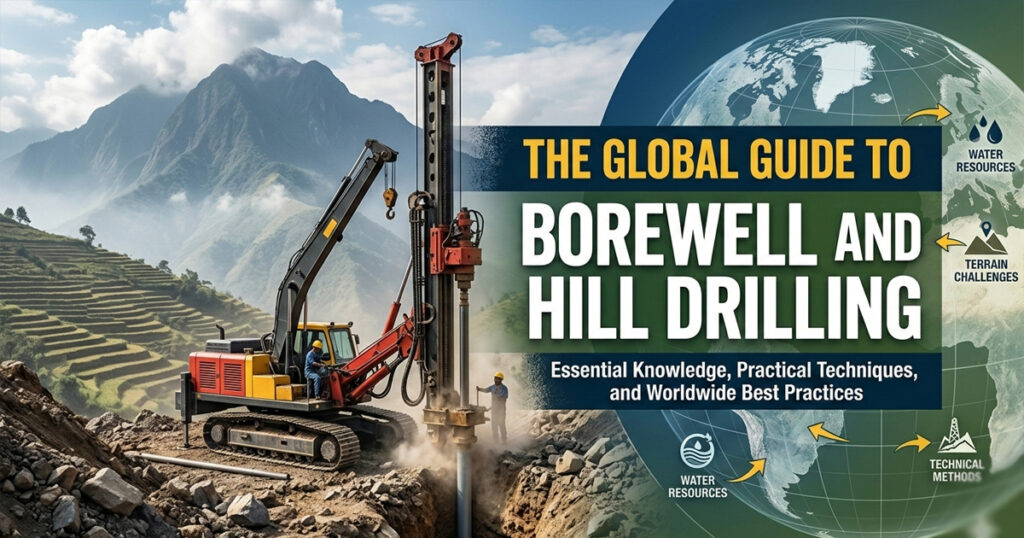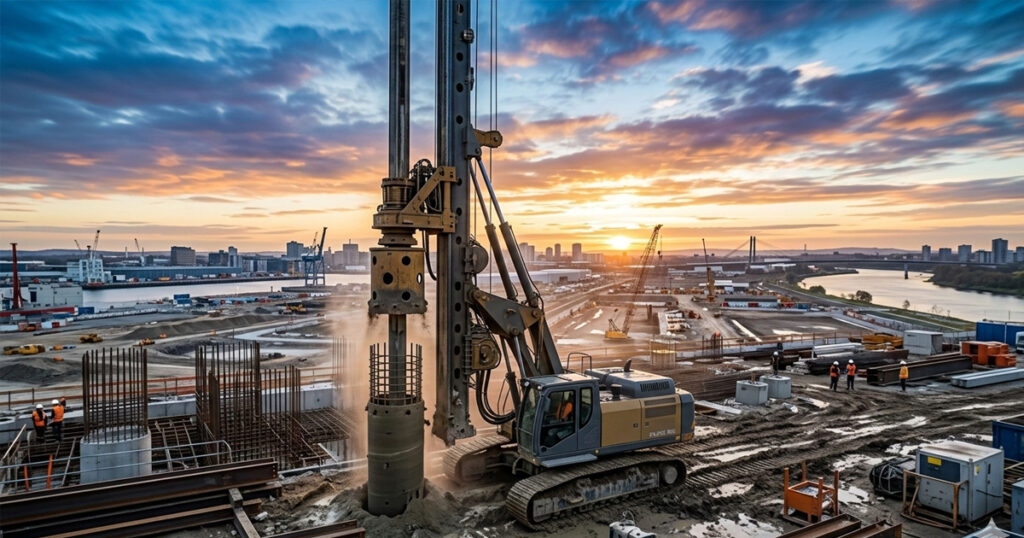
Surface drilling is divided into two primary categories: Hydrogeological Exploration (Borewell) and Horizontal/Inclined Infrastructure (Hill Roads). While both machines utilise the power of percussive and rotational force, their design requirements for torque, air pressure, and chassis stability differ fundamentally.
What is a Borewell & Hill Drilling Rig?
A borehole rig is a heavy-duty machine designed to drill into the earth to reach a water-bearing system. A hill drilling rig is designed for high-gradient conditions.
How it Works: The Physics of AIR Flushing
The most important factor in borewell and hill drilling is the flushing mechanism. As the drill bit shatters the hill, the rock with high-pressure is measured by CFM and PSI. In deep borewells, as the hole deepens, the weight of the air/water column increases, it develop the back pressure.
Core Drilling Methodologies: DTH vs. Rotary
A. Down-The-Hole (DTH) Drilling
Mechanism: A pneumatic hammer located at the bottom of the drill string strikes the bit directly.
Geology: Designed for Hard Rock (Granite, Basalt, Quartzite).
Key Focus: High-volume, high-pressure air required.
Global Standard: Follow the ISO 10424-2 and ASME B-series for rotary connections.
B. Direct Rotary Drilling
Mechanism: Uses high “Pull-down” weight and rotational torque to grind through material, tricone or PDC bit. Its mechanism is similar as piling rig to create deep foundations.
Geology: Designed for soft to medium formations (Clay, Sandstone, Alluvial soil).
Key Focus: Mud Circulation to cool the bit and lift cuttings.
Technical Specifications: Rig Comparison Table
The data aligns with global tier 4/stage v machinery standards (Epiroc, Sandvik, and PRD Rigs).
| Feature | Water Well (Borewell) Rig | Crawler Rock Drill (Hill/Road) |
|---|---|---|
| Typical Depth | 200m – 600m (650ft – 2000ft) |
15m – 45m (50ft – 150ft) |
| Hole Diameter | 150mm – 300mm (6″ – 12″) |
76mm – 115mm (3″ – 4.5″) |
| Torque Requirement | High (Up to 12,000 Nm) | Moderate (Up to 4,000 Nm) |
| Air Pressure (PSI) | 250 – 350 PSI (DTH) | 150 – 250 PSI |
| Chassis / Mobility | Truck-Mounted (High Transit) | Compact Crawler (Off-Road) |
| Engine Standard | EPA Tier 4f / Stage V | EPA Tier 4f / Stage V |
⏱️ Quick Time Estimator
Get an instant estimate for your DTH drilling project duration.
Hill Road Construction: The Crawler Rock Drill
Hill Drilling for the road expansion or tunnelling, and the machine’s gradeability and
Boom coverage are primary specification.
Gradeability: Essential for 30°+ slopes. Featured with oscillating tracks for stability on uneven rock.
Drifter Specifications: Drifter is a hydraulic motor on a mast. For hill roads, a high-frequency drifter (e.g., 200-300 Hz) is required to fracture rock without causing landslides.
Dust Suppression: The modern global mandate is to use water mist or a dry dust collector to avoid silicosis.
Maintenance & Fluid Management (The “Pro” Standard)
| Maintenance Component | Lubricant / Fluid Type | Global Specification (ISO/API) | Interval (Hrs) | Key Performance Intent |
|---|---|---|---|---|
| Main Compressor | Synthetic Compressor Oil | ISO VG 32 / 46 | 500 – 1,000 | Prevents carbon buildup on valves at 350+ PSI. |
| DTH Hammer | Dedicated Rock Drill Oil | ISO VG 100 / 150 | Continuous | High “tackiness” to resist water wash-out. |
| Hydraulic System | Anti-Wear (HV) Oil | ISO VG 46 / 68 | 1,000 – 2,000 | Maintains viscosity under high-pressure cycling. |
| Diesel Engine | Heavy-Duty Multigrade | API CK-4 (15W-40) | 250 – 500 | Crucial for Tier 4 Final SCR/DPF systems. |
| Rotary Head | Extreme Pressure (EP) Oil | API GL-5 / ISO 220 | 1,000 | Protects gears from high-torque shock loads. |
| Thread / Joints | Copper/Zinc Compound | Anti-Seize Paste | Per Rod Change | Prevents “galling” and cold-welding of pipes. |
| Crawler Tracks | Lithium Complex Grease | NLGI 2 EP | 50 – 100 | Flushes out abrasive rock dust and grit. |
Also, blend the lubricant with recognised oil additives. It offers the Extreme Pressure (EP) to protect the machine.
Specialized Applications
Agriculutre & Residential
Hill Infrastructure(installing micropiles for bridge foundations on 30-degree gradients.)
Landslide Mitigation
Global Engineering FAQ
Q: Why does my drilling speed drop at 300 meters?
Ans: It occurs due to back pressure, and the hole increases hydrostatic and frictional resistance, because more air pressure (PSI) is required lift objects out. Hence, if the compressor is 250PSI, it will hit a pressure wall.
Q: What is the difference between a DTH Hammer and a Drifter?
Ans: Down-the-hole (DTH), while Drifter is Top-Hammer. Drifters have a faster cycle for shallow road holes, and DTH is more accurate for deep borewells.
Q: Can I use Engine Oil in my Hydraulic system?
Ans: No, a hydraulic system required for anti-foam and air-release properties that 15W40 engine oil provides.
Q: What is the benefit of oscillating tracks on hill rigs?
Ans: Oscillating tracks enable each crawler to move, and keep the rig’s mast vertical even when the ground is highly uneven, avoiding catastrophic top-overs.