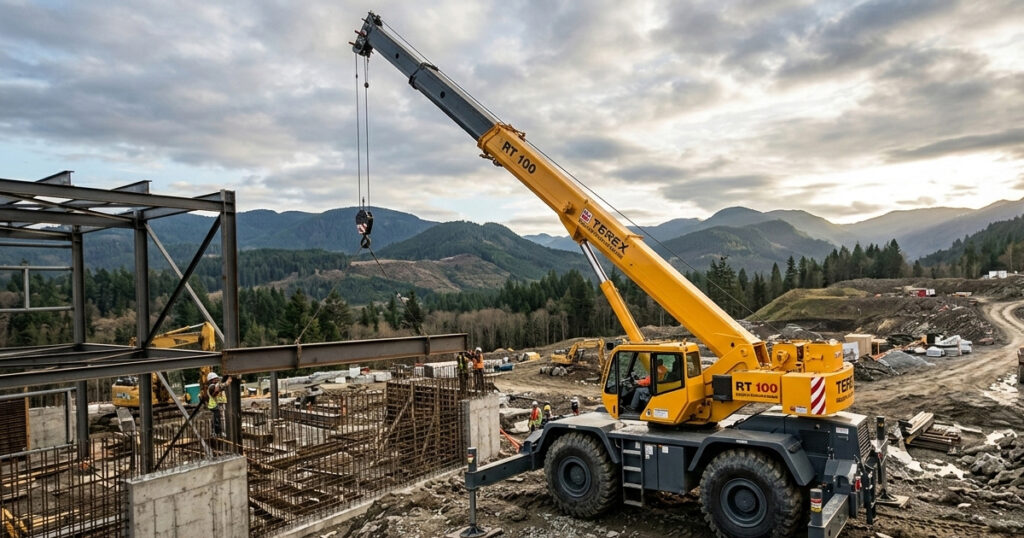
What is a Rough-Terrain Crane?
A Rough Terrain Crane is a compact, single-engine machine attached to a two-axle chassis with four oversized rubber tyre. Outriggers must be fully extended and properly supported before any lift — use our Crawler Crane & Mobile Crane Ground Bearing Pressure Calculator to confirm ground bearing capacity first.”
Off-Road Capability: RT crane features high ground clearance and all-wheel drive, enables them to navigate mud, sand, and uneven surfaces that would stop a standard truck crane.
Pick-and-Carry: Unlike truck cranes, RT cranes are designed for “Pick-and-Carry” materials at a limited distance with the load.
Single Cab: The operator drives the crane from the cabin, which rotates 360 degrees.
Rough Terrain Cranes Technical Specifications
| Feature | Standard RT Crane | Heavy-Duty RT Crane |
|---|---|---|
| Lifting Capacity (SWL) | 30 Tons – 80 Tons | 100 Tons – 160+ Tons |
| Drive & Steering | 4×4 All-Wheel Drive | 4×4 with 3-Mode Crab Steering |
| Boom Configuration | Telescopic Hydraulic | Telescopic with Power Tilt Jib |
| Max Gradeability | Up to 30% Slope | Up to 45% Slope |
| Tire Engineering | Large Earthmoving Tires | Reinforced Deep-Tread Off-Road |
RT Crane Site Readiness Analyzer
Safety Standard: OSHA 1926.1402 / ASME B30.5
How to Operates
RT cranes use a high-torque engine and a specialised transmission to provide maximum power at minimum speeds.
Levelling: On uneven ground, the operator uses the four independent hydraulic power to level the machine perfectly before lifting static material.
Steering Modes: It has three steering features to operate in a tight industrial zone. Front-wheel only, all-wheel synchronised, and crab steer.
Hydrostatic Drive: Many modern RT cranes use a hydrostatic drive system for precise movement while carrying material.
Rough Terrain (RT) vs. All-Terrain (AT) Cranes
| Feature | Rough Terrain (RT) | All-Terrain (AT) |
|---|---|---|
| Axles/Steering | 2 Axles (4×4) | Multi-Axle (All-Wheel) |
| Road Travel | Trailer Required (Slow) | Highway Legal (Fast) |
| Pick & Carry | Excellent (On Rubber) | Limited / Outriggers Only |
| Jobsite Cost | Lower Rental/Maintenance | Higher Operational Cost |
Industry Support
Oil & Gas: Necessary for maintenance in a remote desert where roads don’t exist. Also, add the oil additives when necessary.
Mining: Used for assembling heavy-duty equipment and moving parts in rough quarry conditions.
Infrastructure: Perfect for bridge construction sites, when the ground is often unstable.
Rough Terrain Crane: Operations & Maintenance FAQ
Q: Can a rough-terrain crane be driven on public highways?
Ans: Generally, no. RT cranes feature oversized tires and a wide chassis designed for off-road stability. In most regions across India and the UAE, they are not street-legal and must be transported to the job site via a low-boy trailer.
Q: What is the difference between an All-Terrain (AT) and a Rough-Terrain (RT) crane?
Ans: RT cranes typically have 2 axles, a single cab for both driving and operating, and are purpose-built for off-road maneuvering. In contrast, AT cranes feature 3 to 9 axles and 2 separate cabs, allowing them to travel at highway speeds while still maintaining off-road capability.
Q: How do I maintain the hydraulic system in desert heat?
Ans: In high-temperature environments, it is critical to use ISO VG 68 or 100 hydraulic oil to maintain viscosity. Additionally, ensure that the oil cooler fins are cleaned daily to prevent overheating and check lubricants frequently to avoid thermal breakdown.