Electro-Hydraulic Grab Buckets represents high-precision, self-powered components of bulk material handling.
What are Electro-Hydraulic Grab Buckets?
An electric grab is a self-contained unit featuring an integrated electric motor, hydraulic pump, and cylinders. Power Link: Like an EOT crane, it offers electrical power through a cable reel. An electro-hydraulic grab bucket is a clamshell-style lifting attachment whose mechanism uses its own onboard electric-motor-driven hydraulic power to open and close its jaws.
Action: The electric motor drives the hydraulic pump, which forces high-pressure oil into cylinders to open or close the shell or jaws.
Advantage: The closing force is designed hydraulically, offering more digging pressure than mechanical grabs, making them superior for compacted materials.
Variants & Types of Electro-Hydraulic Grabs
| Variant | Design Engineering | Ideal Materials | Industry Use Case |
|---|---|---|---|
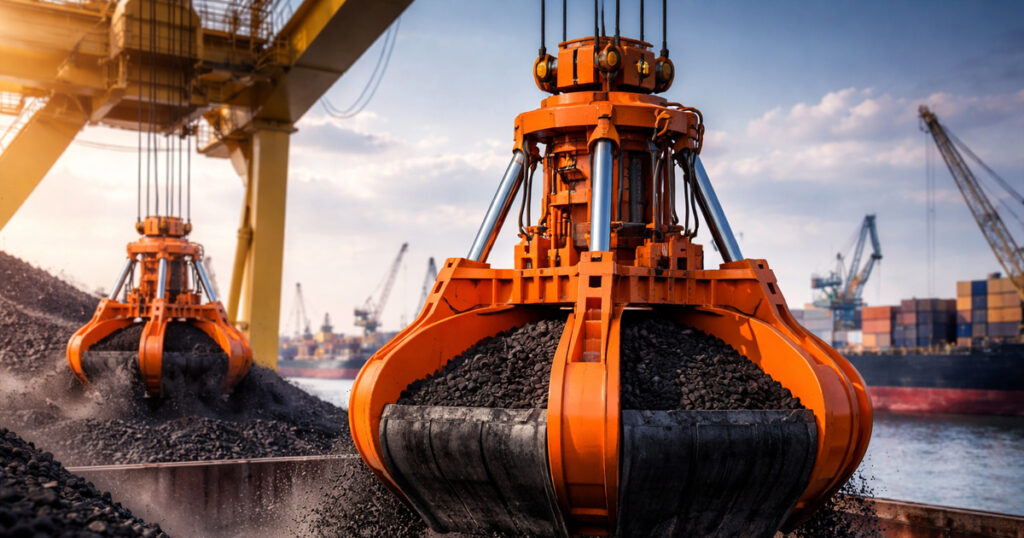
| Clamshell Grab | Two symmetrical shells with precise edge sealing. | Grains, Fertilizers, Cement, Sand, Coal. | Marine Ports & Bulk Storage |
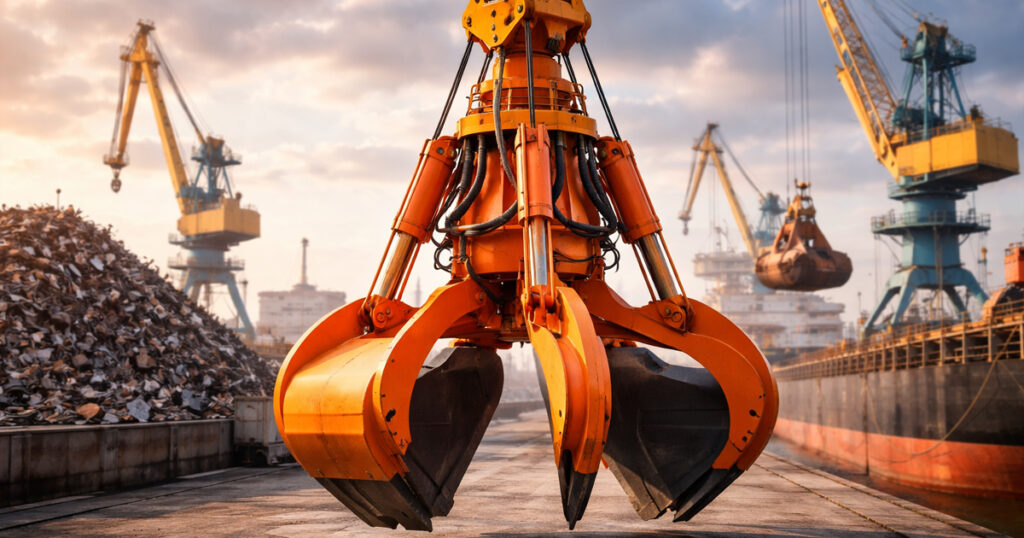
| Orange Peel Grab | 3 to 8 independent semi-enclosed tines. | Steel Scrap, Municipal Waste, Boulders. | Steel Mills & Recycling Plants |
| Rectangular / Log Grab | Wide, flat jaws or specialized tines. | Timber, Logs, Industrial Bundles. | Forestry & Paper Mills |
| Leak-Proof (Eco) | Overlapping shells with rubber seals. | Fine Chemicals, Toxic Powder, Fly Ash. | Chemical Plants & Energy Sector |
EH Grab Cycle Optimizer
Focus: Hydraulic Kinematics & Flow Efficiency
Pro-Standard Technical Specification Table
Grab bucket capacity is specified by volume (cubic meters) and rated for a maximum material density, from a grab rated for a large volume of a light material overloaded on used a dense material at the same fill level.
| Technical Specification | Small Class | Medium Class | Heavy Class | Mega Class |
|---|---|---|---|---|
| Volume Capacity | 1.0 – 3.0 m³ | 5.0 – 10.0 m³ | 12.0 – 20.0 m³ | 25.0 – 50.0 m³ |
| Motor Power (kW) | 7.5 – 15 kW | 22 – 45 kW | 55 – 90 kW | 110+ kW |
| Operating Voltage | 380V – 440V | 380V – 440V | 440V – 690V | High Voltage (HV) |
| Cycle Time (Closing) | ~ 8 Sec | ~ 12 Sec | ~ 18 Sec | ~ 25 Sec |
| Hydraulic Pressure | 180 Bar | 220 Bar | 280 Bar | 320+ Bar |
| Ingress Protection | IP55 / IP66 | IP66 | IP66 (Marine Grade) | IP67 |
Capacity by Material Type
| Material | Typical Density Consideration |
|---|---|
| Coal | Lower density — larger volume grabs commonly used |
| Ore/mineral bulk | Higher density — capacity de-rated versus coal-rated grabs |
| Scrap metal | Highly variable density, irregular shape — grab design (tine-style vs. clamshell) matters significantly |
| Grain/agricultural bulk | Lower density, free-flowing — sealed clamshell design reduces spillage |
(Note: use your specific grab manufacturer’s rated capacity-by-material chart for actual project specification — the table above is a general orientation on why material density matters, not a substitute for certified load data.)
How Electro-Hydraulic Grabs Work
The operation follows a ‘drive drive’ hydraulic sequence. An electric motor mounted on the grab bucket itself drives a hydraulic pump, which pressurizes fluid to increase the hydraulic cylinders. Also, power is supplied via a cable reeling drum on the crane, grab operates independently of the crane’s main hoist mechanism.
Lowering: The grab is lowered onto the material.
Activation: The operator pushes a button in the cab and sends electricity by cable reel to grab the motor.
Pressure Build: The motor spins the pump, forward oil “full bore” side of the cylinders.
The Dig: The jaws close with constant hydraulic force, regardless of whether the material is hard, and a hydraulic relief valve prevents the motor from stalling.
Hoisting: The crane lifts the grab, and its design, hydraulic valve, and cylinder ensure the grab doesn’t open mid-air if power is lost.
Clamshell Opening and Closing Mechanism
The two curved jaws (shells) pivot on central frame, and when hydraulic cylinders extend, the jaws open to scoop or release material, when they retract, the jaws close around the material to lift it. Clamshell bucket mechanism is designed to dig, grab, and handle the bulk material and secure the contain during the lift.
Electro-Hydraulic vs. Mechanical (Rope-Operated) Grabs
| Factor | Electro-Hydraulic Grab | Mechanical (Rope) Grab |
|---|---|---|
| Operating mechanism | Onboard hydraulic power pack | Crane’s own hoist ropes |
| Cycle speed | Generally faster, more consistent | Slower, dependent on rope reeving |
| Control precision | Higher — independent of crane hoist load | Lower — tied to crane hoist behavior |
| Maintenance complexity | Higher (hydraulic components, electric motor) | Lower (fewer moving systems) |
| Best suited for | High-cycle, continuous bulk handling operations | Lighter-duty or occasional grab use |
Common Applications
Bulk Cargo and Port Handling
Electro-hydraulic grabs are widely used on ship unloaders and port cranes for handling loose bulk cargo like coal, grain, and ore.
Scrap Yards and Recycling
Scrap handling grabs with strong tines or a heavy-duty clamshell design, from scrap material is irregular and it is more abrasive on grab components than uniform bulk materials.
Coal and Ore Handling
Power plants and mining operations use electro-hydraulic grabs for stockpile management and rail/ship loading, where fast and continuous cycle matter as much as raw lifting capacity.
Hydraulic power pack and its own electric motor components in the grab, maintenance requires needs are higher than the normal mechanical grabs. And, regular hydraulic fluid checks, seal inspection, and electrical connection checks on the cable reeling system. Hence, every machine need timely repair, services and oil and lubrications for high-cycle environments.
Technical Frequently Asked Questions
Why use an electro-hydraulic grab instead of a mechanical one?
Both operate differently. Electro-hydraulic grabs maintain 100% closing force throughout the entire operation, whereas mechanical grabs lose power as they close. Additionally, many manufacturers offer 100% waterproof electric grabs specifically designed for underwater operations.
What is the most critical maintenance item?
The cable reels are the most critical maintenance item. Because the grab moves up and down constantly during operation, the power cable is subjected to continuous dynamic loads and strain.
What is the difference between electro-hydraulic and mechanical grabs?
Electro-hydraulic grabs use an onboard hydraulic power pack powered by the overhead crane’s electricity to open and close, delivering faster and more precise cycles compared to mechanical grabs that rely directly on the crane’s hoist ropes.
What materials are electro-hydraulic grabs used for?
Common applications include coal, ore, cement, iron, grain, and scrap metal handling. The effective grab capacity and shell design are varied depending on the material’s bulk density.
How much power does an electro-hydraulic grab need?
The electric motor is powered via a cable reeling drum on the crane. Power requirements vary by grab capacity and manufacturer, so confirm your crane’s auxiliary power supply is compatible before specifying a grab bucket.
Are electro-hydraulic grabs more expensive to maintain than mechanical grabs?
Generally yes — the added hydraulic and electrical components require more maintenance touchpoints than a mechanical grab, but this is offset by significantly faster cycle times and better throughput in high-duty operations.